
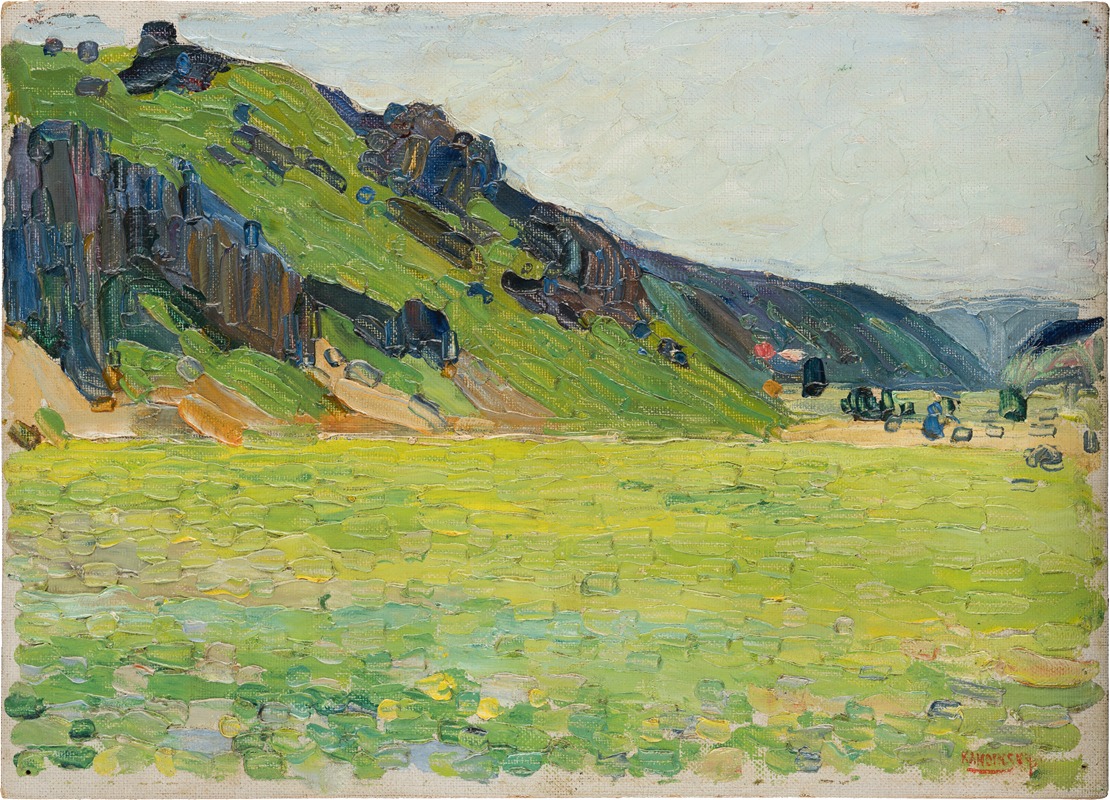
Kallmünz—Light-Green Mountains
1903
- Dimensions
- 23.5 x 32.8 cm
- Medium
- Oil on primed canvas, mounted on cardboard
- Collection
- Städel Museum
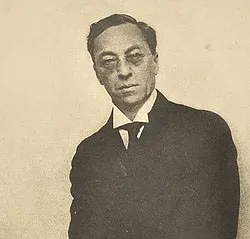
Wassily Wassilyevich Kandinsky was a Russian painter and art theorist. Kandinsky…
✦ Highlights (technique & color)
Employing palette knives and brushes with great freedom, the artist applied thick, undiluted layers of paint. Anchored by multi-layered gradations of green—such as olive and emerald—and contrasted with striking yellows and teal tones, the work captures the early summer sunlight and the shimmering atmosphere.
✦ The setting of this painting
Kallmünz is an ancient town near Regensburg in the Upper Palatinate region of Bavaria. Situated where the Naab and Vils rivers converge, it is defined by a rocky outcrop crowned by medieval castle ruins and historic houses clustered in the valley below. It was here that Kandinsky captured the vibrant shimmer of light radiating from the natural landscape.
✦ Historical context
Between 1901 and 1903, Kandinsky organized the avant-garde artists' association Phalanx in Munich. Resisting academic and conservative traditions, this period saw him eagerly explore pioneering expressive techniques, notably those of French Post-Impressionism.
Gently rolling green mountain slopes fill the entire canvas.
In the foreground, a vibrant light green.
In the distance to the right, a cluster of small houses comes into view.
Summer 1903.
Twenty-five-year-old Gabriele Münter was crossing a river by boat.
Her destination was the historic Bavarian town of Kallmünz—
a picturesque town nestled in a valley beneath rocky hills crowned by medieval castle ruins.
As she arrived at the harbor, a lone bicycle greeted her.
Riding it was Wassily Kandinsky.
He was thirty-six at the time—
a teacher at the art school she attended, and already a married man.
Having arrived in the town ahead of her, he had been eagerly awaiting her arrival.
Together, the two set up their easels in this town.
Days spent capturing the landscape with a camera and taking up their paintbrushes.
In an era when the doors of art academies remained firmly closed to women, her time with someone who held her talent in such deep regard was truly special.
And that summer,
here in Kallmünz, they secretly pledged their engagement.
A vow they could share with no one.
About 110 more words
Read stories of masterpieces for free
Your Note
Write down what this painting made you feel in your art notebook.
Please sign up to write notes.
Sign up for freeRecommended Artworks
_by_Ilya_Repin_-_%D0%9D%D0%B5%D0%B0%D0%BF%D0%BE%D0%BB%D0%B8%D1%82%D0%B0%D0%BD%D0%BA%D0%B0.webp)
Sources & references
More artists
If you find an error in this content, please let us know here
This site is protected by reCAPTCHA, and the Google Privacy Policy and Terms of Service apply.