
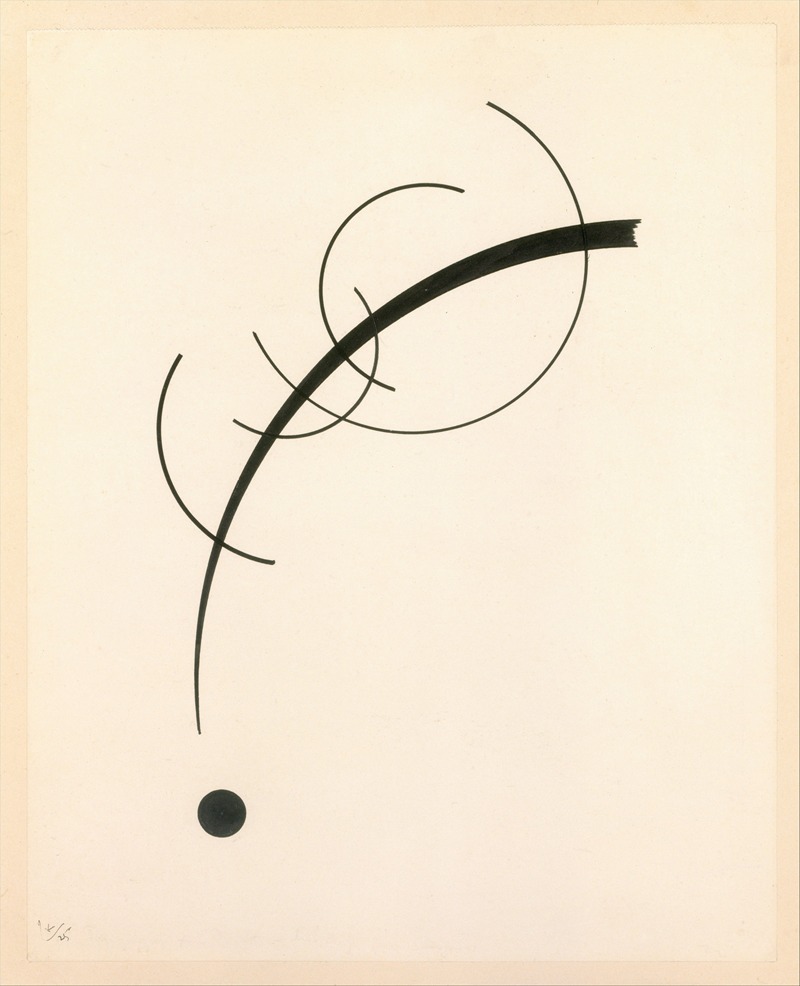
Free Curve to the Point – Accompanying Sound of Geometric Curves
1925
- Dimensions
- 台紙:46.3×38.3 cm、用紙:38.5×30.5 cm
- Medium
- Ink on paper, mounted on cardboard
- Collection
- The Metropolitan Museum of Art (New York, USA)
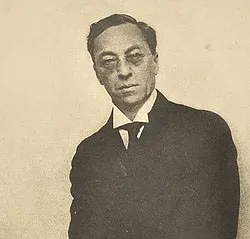
Wassily Wassilyevich Kandinsky was a Russian painter and art theorist. Kandinsky…
✦ Highlights (technique & color)
Completely devoid of color, the composition is rendered solely in black ink. The focus rests on the controlled, continuous variation in line weight and the intuitive dynamism of the hand-drawn "free curve." Rather than inorganic, mechanical lines, they are depicted as forms imbued with the breath of life.
✦ The setting of this painting
The setting is a flat, white, two-dimensional sheet of paper, presenting a "weightless spiritual space" entirely detached from the physical world. Bold, dynamic curves and delicate straight lines cut diagonally across the surface, converging upon an isolated, motionless point to evoke a tension between static finality and dynamic progression.
✦ Historical context
Created in Weimar in 1925, this work dates from the period when Kandinsky was conducting intensive research for his Bauhaus lectures on graphics, analytical drawing, and basic form studies. It is directly linked to the linear analytical diagrams published the following year in his book, Point and Line to Plane.
Lines of black ink are drawn across a sheet of pure white paper.
Bold, powerful curves and delicate, razor-thin lines intersect as they converge toward a single black point.
Wassily Kandinsky.
Born in Moscow in 1866, he was not originally an artist.
He studied law and economics at the University of Moscow.
He achieved such outstanding academic success that he was even offered a professorship in Roman law.
A promising career among the elite awaited him.
Yet he chose to walk away from it.
At the age of thirty,
he resolved to become a painter and left for Munich.
Roughly thirty years later, in 1925,
he created this drawing in Weimar.
At the time, he was teaching at the Bauhaus.
It was a period when he was deepening his research for his lectures on graphics and analytical drawing.
Together with his students, he conducted an experiment:
to interpret the visual relationship between points and lines as sound.
He possessed synesthesia, experiencing colors and shapes as sounds.
He sought to expand this sensory perception even further.
About 132 more words
Read the rest of this commentary —
and step into a secret gallery
opened just for you
An "art letter" delivered to you every Saturday morning
Works, music and words chosen for your sensibility, from your artist-type result and the paintings you love
A library of masterpieces and music you can enjoy "in your own words", not just look at
A "digital art notebook" (unlimited) where your impressions build into your own taste
Unlimited likes and notes
¥980 / month¥0 today
¥980/month (tax incl.) from day 8. Cancel anytime.
Already have an account? Log in
Your Note
Write down what this painting made you feel in your art notebook.
Please sign up to write notes.
Sign up for freeRecommended Artworks
_by_Ilya_Repin_-_%D0%9D%D0%B5%D0%B0%D0%BF%D0%BE%D0%BB%D0%B8%D1%82%D0%B0%D0%BD%D0%BA%D0%B0.webp)
Sources & references
More artists
If you find an error in this content, please let us know here
This site is protected by reCAPTCHA, and the Google Privacy Policy and Terms of Service apply.