
Leichtes
1930
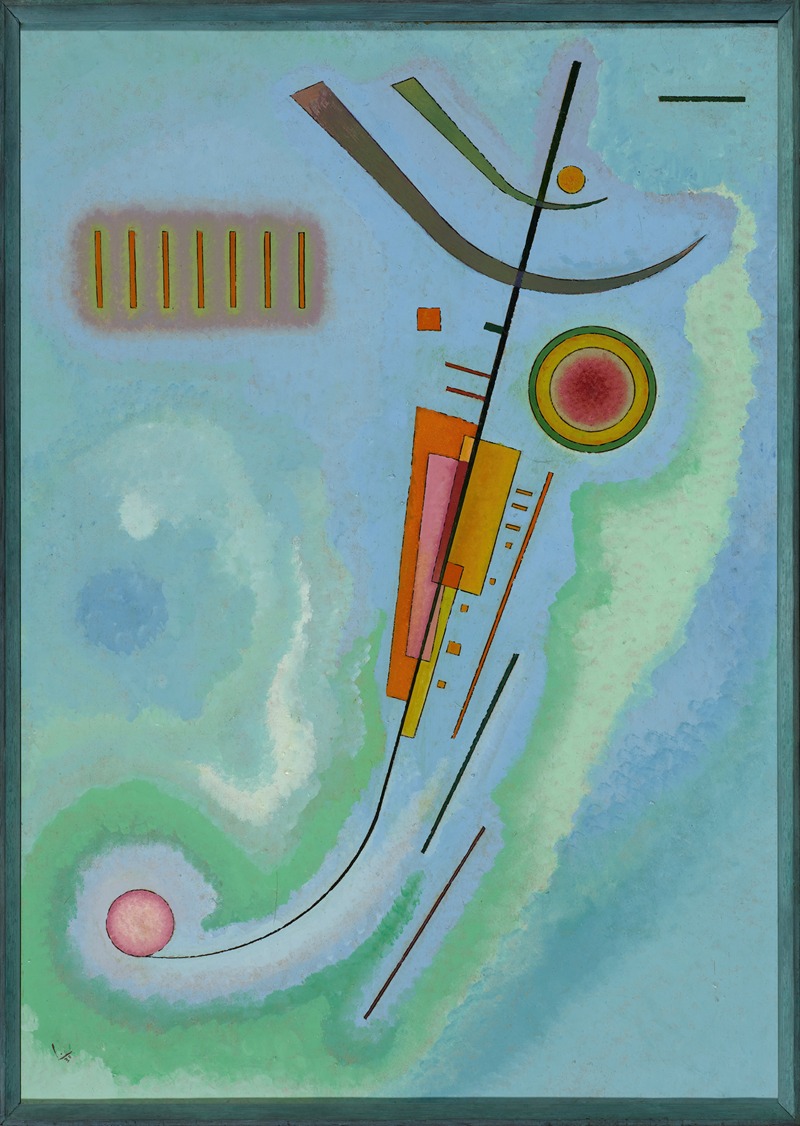
- Dimensions
- 69 × 48 cm
- Medium
- Ripolin (industrial enamel paint) on cardboard
- Collection
- Centre Pompidou / Musée National d'Art Moderne, Paris, France
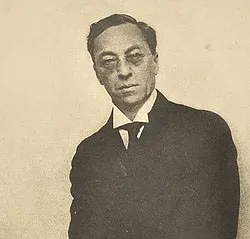
Wassily Wassilyevich Kandinsky was a Russian painter and art theorist. Kandinsky…
✦ Highlights (technique & color)
Rather than traditional canvas and oil paint, this work was executed on cardboard using Ripolin, an industrial enamel paint that was cutting-edge at the time. It is characterized by a smooth, high-gloss finish free of visible brushstrokes. Structured around black diagonal lines, minute elements such as pastel rectangles and pink circles are harmoniously arranged. The sharp contours of the opaque shapes create a vivid contrast with the blue background.
✦ The setting of this painting
No specific physical location is depicted. The setting is a mystical, hazy celestial realm rendered in gradations of pale turquoise blue. In this atmospheric space entirely devoid of gravity, countless small geometric objects float, coming together as a magnificent visual constellation.
✦ Historical context
Created in 1930 at the Bauhaus in Dessau, Germany. At the time, the school faced intense pressure and mounting hostility from right-wing political factions and the Nazi party, including cuts to public funding and threats of closure. As if to counter the turbulent noise of the outside world, Kandinsky sought to crystallize harmony and lightness in this piece.
Countless small shapes float within a hazy expanse of pale turquoise blue.
They appear like a magnificent constellation spreading across a weightless sky.
Dessau, Germany, 1930.
The Bauhaus, where Kandinsky taught, was severely shaken.
Opposition from right-wing factions and the Nazis was intensifying.
Public funding was slashed, and pressure to close the school mounted day by day.
Amid such a tense social climate.
As if to counter the unsettling noise of the outside world, he took up his brush in his studio.
What he sought was harmony and lightness.
Setting aside canvas and oil paint, he turned to cardboard.
He reached for Ripolin, a modern industrial enamel paint.
Leaving no visible brushstrokes, this paint yielded a smooth and glossy finish.
He sought to bring the aesthetics of industrial design directly onto the painting surface.
He even painted the custom wooden frame himself,
allowing the spiritual space within the picture to bleed out into the surrounding world.
About 141 more words
Sign up free and enter Your Museum
Read the stories behind great paintings and music for free, in Your Museum
Your Note
Write down what this painting made you feel in your art notebook.
Please sign up to write notes.
Sign up for freeRecommended Artworks
_by_Ilya_Repin_-_%D0%9D%D0%B5%D0%B0%D0%BF%D0%BE%D0%BB%D0%B8%D1%82%D0%B0%D0%BD%D0%BA%D0%B0.webp)
Sources & references
More artists
If you find an error in this content, please let us know here
This site is protected by reCAPTCHA, and the Google Privacy Policy and Terms of Service apply.