
Klänge Pl.25
1913
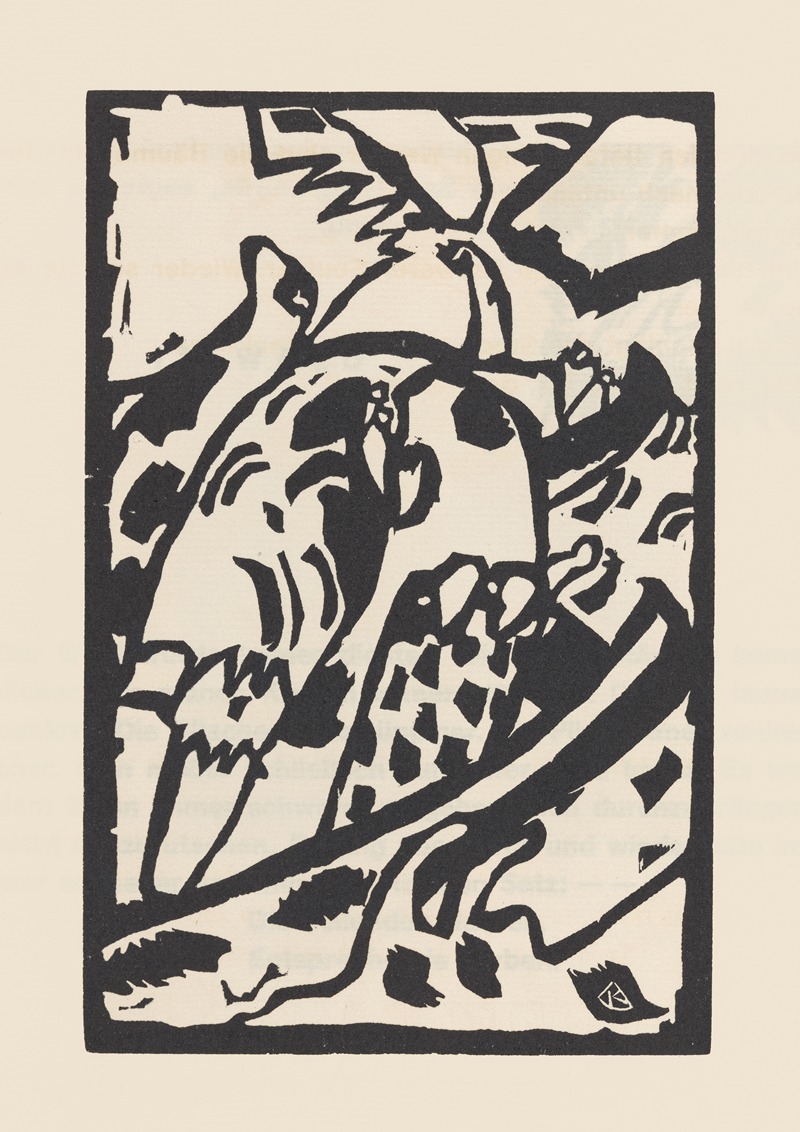
- Dimensions
- 21.8 x 22.0 cm
- Medium
- Monochrome woodcut on smooth, light cream Van Gelder Zonen wove paper
- Collection
- The Museum of Modern Art (MoMA), New York
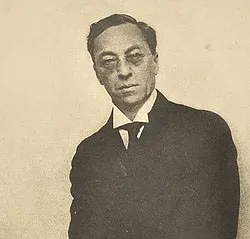
Wassily Wassilyevich Kandinsky was a Russian painter and art theorist. Kandinsky…
✦ Highlights (technique & color)
A monochrome woodcut printed on smooth, light cream wove paper. Sharp angles, undulating curves, and fragmented geometric shapes are densely arranged across the composition. The layering of these intricate forms brings forth a dynamic harmony amidst chaos.
✦ The setting of this painting
No specific, real-world space is depicted. Concealed within the composition, framed by serpentine, writhing forms, is a highly abstracted motif of an embracing couple—a work sometimes referred to in catalogues as Garden of Love. It presents a dynamically harmonious space, translating the intense acoustic pressure and resonance of an orchestral tutti onto the retina.
✦ Historical context
Created in 1913, an era swept by rapid industrialization and the rise of materialism. In response, Kandinsky advocated for a revival of spirituality. Klänge (Sounds), the illustrated book in which this work was published, was conceived as a "musical album" fusing poetry, visual art, typography, and negative space, exerting a profound influence on subsequent recitation performances of Dada and Futurism.
The entire composition teems with sharp angles and undulating curves.
Fragmented geometric forms.
Black and white lines and planes collide with fierce intensity.
It is as though the overwhelming sonic pressure and vibrations of a full orchestral tutti have been seared directly onto the retina.
At first glance, it appears that nothing recognizable is depicted.
Merely chaotic, abstract patterns.
Yet concealed within these intricately tangled lines are the figures of a man and woman embracing.
Munich, 1913.
Kandinsky was planning the publication of his book "Klänge" (Sounds).
A volume that fused poetry, visual art, typography, and negative space on equal terms.
It was a magnificent "musical album" designed to offer the reader a multisensory, synesthetic experience.
For this publication, he had spent the years from 1907 to 1912 carving the woodblocks with his own hands.
The continuous thread running through the book is the figure of the "knight" leading humanity toward a new spiritual world.
He believed that formal elements devoid of physical representation would serve as a direct medium to vibrate the human soul.
His publisher, Reinhard Piper, however, was skeptical.
"It will never sell."
Piper was convinced that this radical composition would end in commercial disaster.
Yet Kandinsky refused to back down.
He accepted the harsh condition of personally guaranteeing the entire production cost.
Only then did he finally wrest permission for its publication.
Printed on fine, pale yellow wove paper, it was issued in a limited edition of 300 copies, signed and numbered by the artist.
The outcome was just as Piper had anticipated.
More than two years after its release, barely 120 copies had been sold.
The planned Russian edition fell through entirely.
He was left to shoulder a substantial financial loss for the sake of his ideals.
Confronted with the incomprehension of those around him and catastrophic commercial failure,
he nevertheless remained steadfast in his artistic convictions.
About 140 more words
Read stories of masterpieces for free
Your Note
Write down what this painting made you feel in your art notebook.
Please sign up to write notes.
Sign up for freeRecommended Artworks
_by_Ilya_Repin_-_%D0%9D%D0%B5%D0%B0%D0%BF%D0%BE%D0%BB%D0%B8%D1%82%D0%B0%D0%BD%D0%BA%D0%B0.webp)
Sources & references
More artists


If you find an error in this content, please let us know here
This site is protected by reCAPTCHA, and the Google Privacy Policy and Terms of Service apply.