
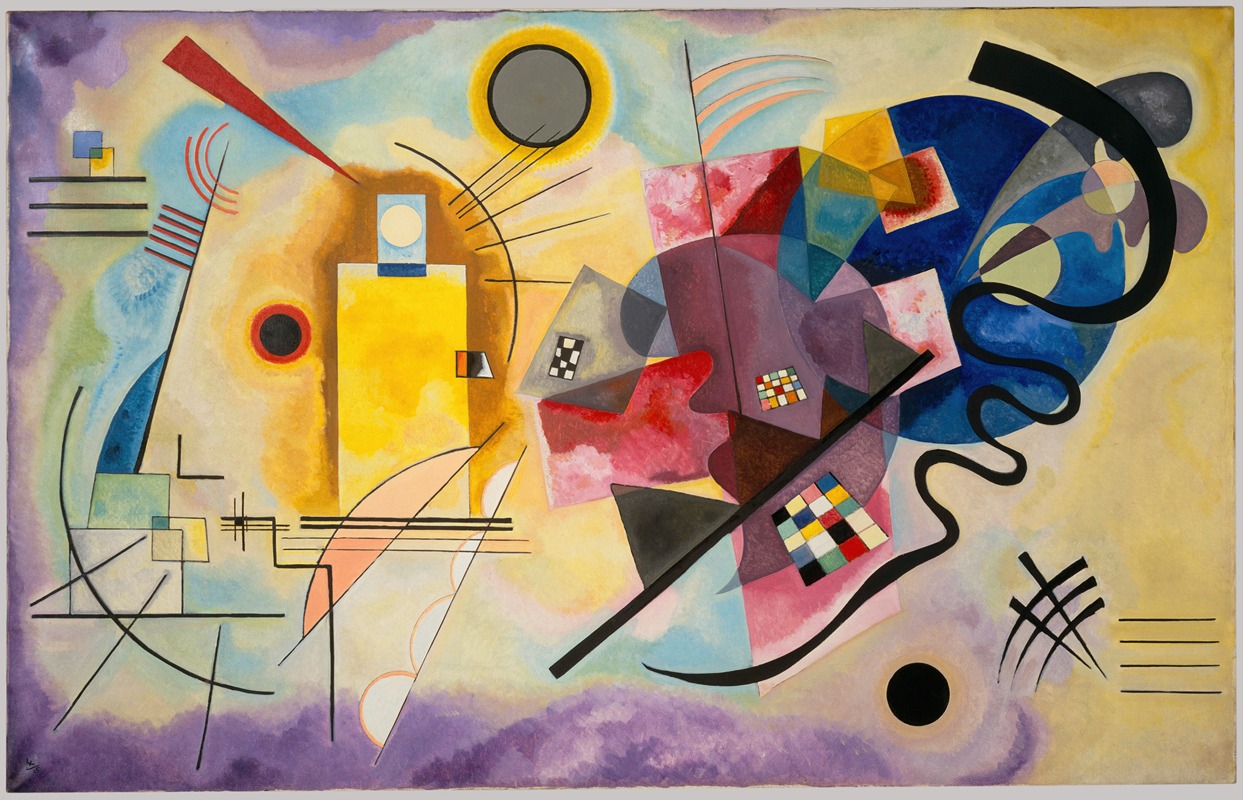
Yellow-Red-Blue
1925
- Dimensions
- 128 × 201.5 cm
- Medium
- Oil on canvas
- Collection
- Centre Pompidou, Musée National d'Art Moderne (Paris, France)
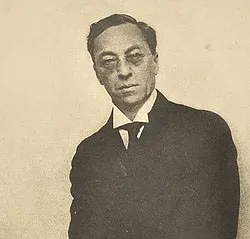
Wassily Wassilyevich Kandinsky was a Russian painter and art theorist. Kandinsky…
✦ Highlights (technique & color)
In contrast to the thin, watercolor-like washes of the background, the circles and triangles in the foreground are rendered in smooth, opaque layers of oil paint. The composition demonstrates chromatic shifts wherever lines intersect other contours, while scattered grid patterns introduce spatial distortion and a sense of weightlessness to the flat surface.
✦ The setting of this painting
This work does not depict a specific physical landscape; rather, it portrays a spiritual microcosm grounded in the artist's synesthesia and the psychology of form. The yellow rectangular shape on the left suggests the profile of a human head or the silhouette of a bottle, presenting an optical ambiguity that engages the viewer's perception.
✦ Historical context
In 1925, the Bauhaus—where Kandinsky taught—was forced to cease operations in Weimar due to political pressure from right-wing factions, amidst turbulent preparations for its relocation to Dessau. During this precarious transitional period, he was actively systematizing his theory of form.
On the left are bright yellow squares and straight lines.
On the right, blue circles and intricately intertwined black curves are depicted.
In the center sits a tilted red cross.
The year was 1925.
Wassily Kandinsky was teaching at the Bauhaus art school.
About three years had passed since he had been invited to serve as a master of the mural workshop.
At the time, the Bauhaus was deeply unsettled.
Facing political pressure from right-wing factions,
the school was forced to close its doors in Weimar.
It was in the midst of chaotic transition as it prepared to relocate to Dessau.
Despite these precarious circumstances,
Kandinsky continued to systematize his artistic theories.
He experienced synesthesia, perceiving colors as carrying distinct emotions and musical resonances.
Yellow is intense and aggressive,
corresponding to sharp triangles and evoking the shrill sound of a trumpet.
Blue is introspective and cool,
corresponding to circles that draw one into the spiritual realm, carrying the profound resonance of an organ or cello.
And red acts as a transition, passionate yet restrained,
likened to the toll of church bells or the rich voice of an alto.
About 114 more words
Read the rest of this commentary —
and step into a secret gallery
opened just for you
An "art letter" delivered to you every Saturday morning
Works, music and words chosen for your sensibility, from your artist-type result and the paintings you love
A library of masterpieces and music you can enjoy "in your own words", not just look at
A "digital art notebook" (unlimited) where your impressions build into your own taste
Unlimited likes and notes
¥980 / month¥0 today
¥980/month (tax incl.) from day 8. Cancel anytime.
Already have an account? Log in
Your Note
Write down what this painting made you feel in your art notebook.
Please sign up to write notes.
Sign up for freeRecommended Artworks
_by_Ilya_Repin_-_%D0%9D%D0%B5%D0%B0%D0%BF%D0%BE%D0%BB%D0%B8%D1%82%D0%B0%D0%BD%D0%BA%D0%B0.webp)
Sources & references
More artists

If you find an error in this content, please let us know here
This site is protected by reCAPTCHA, and the Google Privacy Policy and Terms of Service apply.