
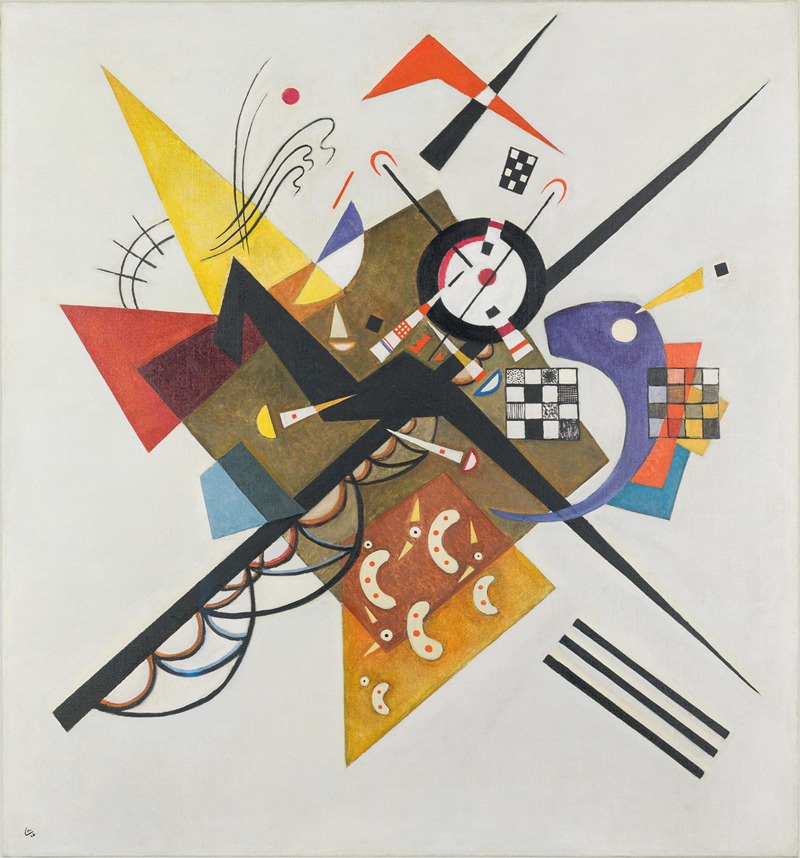
On White II
1923
- Dimensions
- 105 × 98 cm
- Medium
- Oil on canvas
- Collection
- Centre Pompidou (Musée National d'Art Moderne, Paris, France)
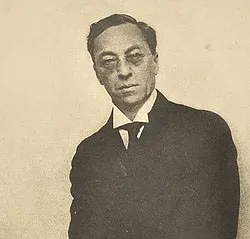
Wassily Wassilyevich Kandinsky was a Russian painter and art theorist. Kandinsky…
✦ Highlights (technique & color)
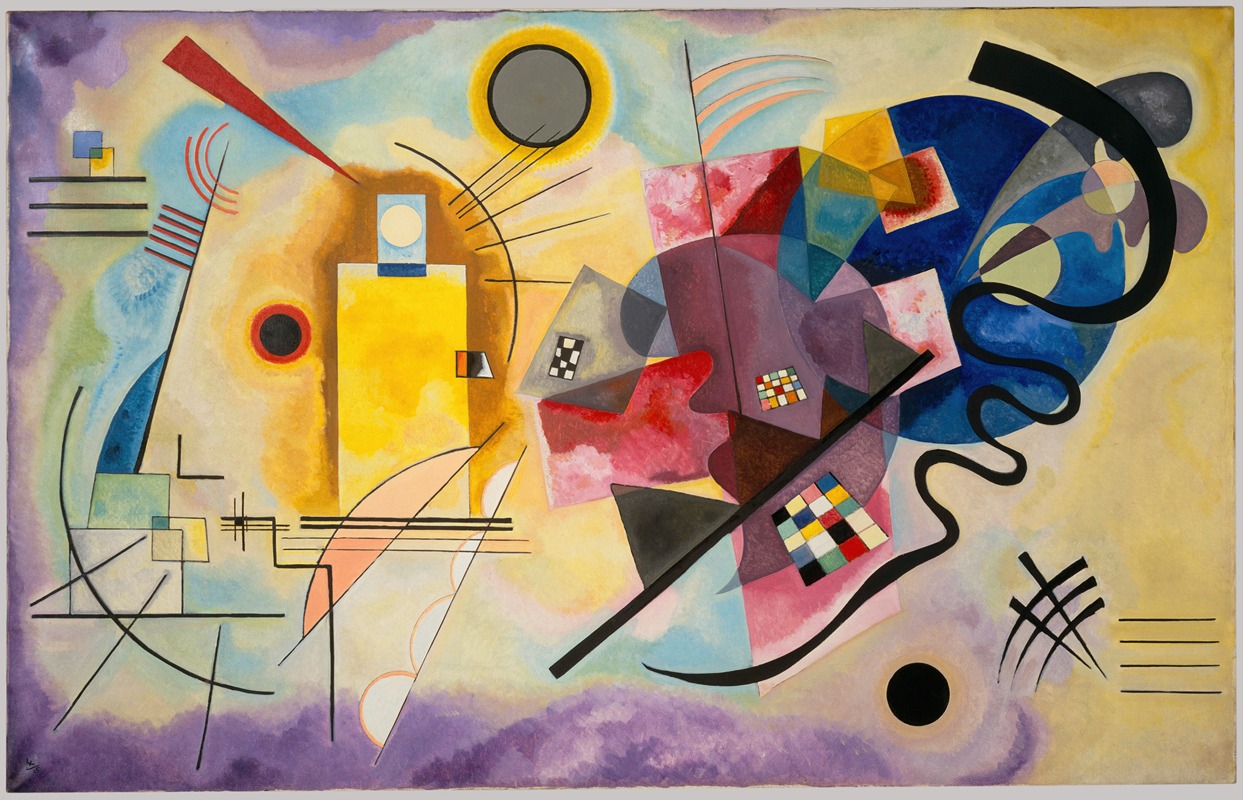
Inspired by Russian Constructivism and other contemporary movements, the defining feature of this piece is its composition of pure geometric forms. Across an almost square canvas, circles, sharp triangles, and checkerboard patterns appear to shatter outward from a central centrifugal force. Against a white background evocative of infinite depth, vivid primary colors—red, yellow, and blue—overlap to create secondary hues, all pierced by bold black lines that maintain a flawless balance across the canvas.
✦ The setting of this painting
Rather than depicting a specific real-world landscape, the work unfolds in a cosmic space divorced from gravity. Beneath the surface, however, lie the mythological and Christian themes that Kandinsky had explored since his Russian period. The Russian landscape motifs he once painted—such as deep northern forests and onion domes of churches—have transformed into sharp triangles, floating weightlessly through the void.
✦ Historical context
Painted in 1923, this work dates from the period when Kandinsky was teaching as a master at the Bauhaus in Weimar, Germany. Having returned to Germany to escape the turmoil following the Russian Revolution, he resonated with the school's rationalist and forward-thinking design philosophy. He refined his intuitive aesthetics into a more logical, structural approach, immersing himself in the study of the psychological and spiritual effects that geometric elements exert on the human psyche.
Against a white background float circles, sharp triangles, squares, and checkerboard patterns. Crossing forcefully across them, bold black lines seem to tear through the composition diagonally.
At first glance, it might appear to be a purely geometric composition devoid of any real-world landscapes or figures.
A logical arrangement of elements—points, lines, and planes—that Kandinsky taught at the Bauhaus.
A cold, emotionless abstract painting.
That is often how it is perceived.
Yet deep beneath the surface, there lies a concrete motif that he had been depicting for years.
In 1917, Kandinsky married Nina Andreevskaya, the daughter of a Russian general, in Moscow.
With Nina, who was much younger than he, he was blessed with a beloved only son.
Tragically, the child passed away at just three years of age.
A profound grief.
Moreover, the turmoil following the Russian Revolution closed in on them.
Fleeing their homeland, the couple returned to Germany at the end of 1921.
In 1923, Kandinsky was teaching as a master at the Bauhaus in Weimar.
Resonating with the Bauhaus's rational and progressive design philosophy, he refined his intuitive aesthetic into a more structured, logical approach.
Before embarking on this canvas, he produced an extraordinarily precise preparatory study in Indian ink and watercolor dated December 22, 1922, to solidify the composition.
It was also a revisiting of an earlier work from 1920.
The dominant diagonal piercing sharply through the center of the canvas.
And the sharp, black, cross-like forms.
These are not merely lines.
They have been identified as the ultimate abstraction of the lance held by Saint George on horseback, a motif he had previously depicted figuratively.
Elements that were once rendered as Russian landscapes—deep northern forests and onion domes of churches—have transformed completely into sharp triangles and jagged contours, suspended in a cosmic space free from gravity.
Having overcome tragedy, Kandinsky and Nina found life at the Bauhaus peaceful and fruitful.
He felt a deep affection and pride for the finished painting.
When the Bauhaus relocated to Dessau in 1925, he proudly hung this work in the dining room of the apartment he shared with Nina.
About 119 more words
Sign up free and enter Your Museum
Read the stories behind great paintings and music for free, in Your Museum
Your Note
Write down what this painting made you feel in your art notebook.
Please sign up to write notes.
Sign up for freeRecommended Artworks
_by_Ilya_Repin_-_%D0%9D%D0%B5%D0%B0%D0%BF%D0%BE%D0%BB%D0%B8%D1%82%D0%B0%D0%BD%D0%BA%D0%B0.webp)
Sources & references
More artists
If you find an error in this content, please let us know here
This site is protected by reCAPTCHA, and the Google Privacy Policy and Terms of Service apply.