
 日本語 (JA)
 English (EN)
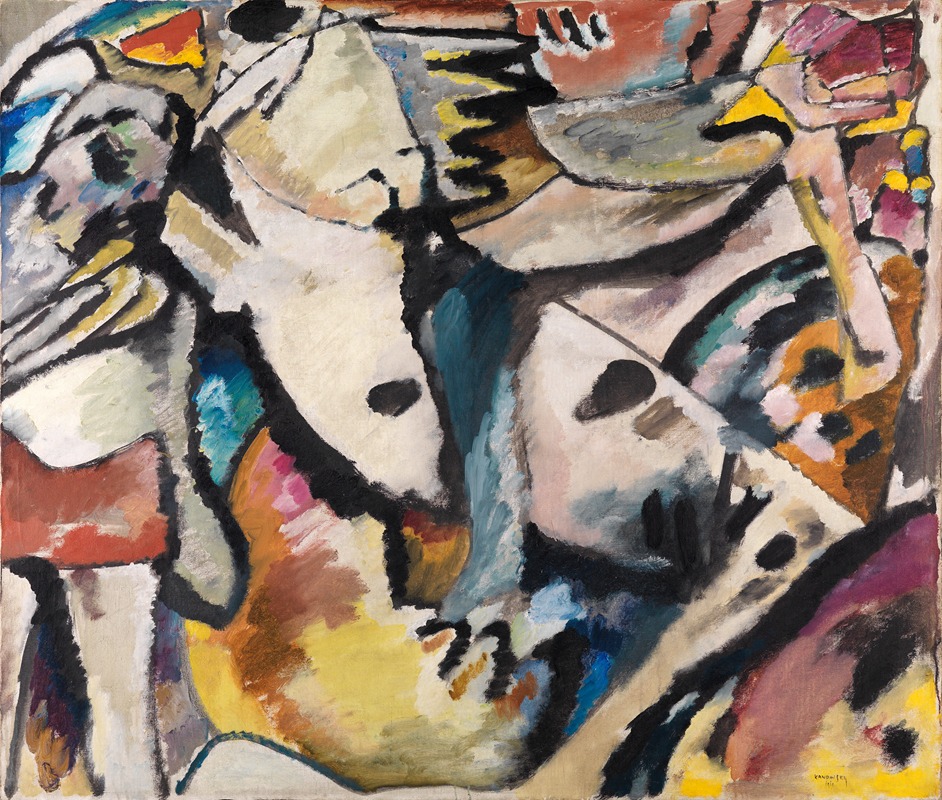
Improvisation 13
1910
- Dimensions
- 120 × 140 cm
- Medium
- Oil on canvas
- Collection
- Staatliche Kunsthalle Karlsruhe
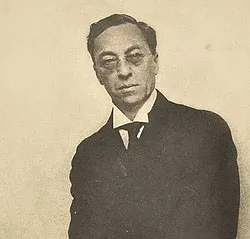
Wassily Wassilyevich Kandinsky was a Russian painter and art theorist. Kandinsky…
アカデミズムや自然主義絵画の限界に強い危機感を抱き、観客が表面的な筋追いに捉われるのを防ぐため、あえて具象的な形を隠し、魂の響きを直接届ける完全な自主制作作品を描いた。
✦ Highlights (technique & color)
Though appearing chaotic at first glance, the work is composed as an 'organized chaos' where intuition and structure maintain a flawless balance. Dynamic arrangements of red, yellow, and blue surge across the canvas, held together by bold, web-like black lines. Kandinsky's synesthesia—experiencing sound through color—is fully realized here: deep blue visually conveys the introspective timbre of a flute, while vibrant yellow expresses the piercing energy of a trumpet.
✦ The setting of this painting
While no specific external landscape is depicted, memories of Moscow—the artist's spiritual homeland—are embedded as visual ciphers. Glimpses of golden onion domes reminiscent of Moscow cathedrals appear in the upper right, while a rider on a white horse, charging forward to break through material civilization toward the future, is boldly positioned across the diagonal. The setting is not a real-world space, but an inner spiritual landscape of the artist.
✦ Historical context
In 1910, Germany and Russia were in a transitional period where traditional feudal structures and academic art traditions were dissolving, giving rise to fervent avant-garde movements. Leading the Neue Künstlervereinigung München (New Artists' Association of Munich), Kandinsky was accelerating his breakthrough into pure abstraction, moving away from depicting visible reality to directly express the human inner world. The turbulent spirit of an era where old material civilization was crumbling to usher in a new spiritual age forms the backdrop of this work.
Munich, Germany, 1910. Standing before a canvas in the quiet of his studio, the forty-four-year-old Wassily Kandinsky listened intently to his inner voice. A paintbrush was clasped firmly in his hand, and vibrant primary colors were arrayed across his palette. Yet what he sought to paint was neither the scenic view outside his window nor an imposing portrait of a grand figure. What he was about to unleash upon the canvas was nothing less than the wordless resonance of the soul.
He could no longer find purpose in traditional painting that merely replicated the visible, material world. In a new era where scientific progress was shaking the very certainty of solid matter, what he pursued was an expression capable of stirring profound human emotions directly. Moving without hesitation, his hand guided the brush across the canvas, where the tremors of his own spirit coalesced into an unfolding tapestry of color and line.
Chaos Like a Shaken Aquarium?
When this deeply personal work was first exhibited in 1910, conservative critics greeted it with intense bewilderment and indignation, dismissing it as the painting of a madman who had lost his senses. To audiences steeped in traditional academic aesthetics, a canvas in which the forms of visible reality were dismantled was utterly incomprehensible.
Critics of the time disparaged the piece, comparing it to a tropical fish tank that had been violently shaken around. To their eyes, the dynamic play of vibrant color patches and sweeping black lines appeared as nothing more than senseless chaos. Newspaper reviews unleashed harsh vitriol, subjecting a work into which the artist had poured his very soul to cold public ridicule.
Yet Kandinsky refused to yield to the public's incomprehension. He remained resolutely convinced that he was on the right path. For him, depicting the easily recognizable forms demanded by critics would have meant straying from the true purpose of art. Rather than superficial beauty, he sought to converse with viewers on a far deeper, spiritual plane.
Memories of Home Hidden Within the Canvas
Though the composition may seem chaotic at first glance, motifs imbued with the artist’s heartfelt memories are woven into it like secret ciphers. In the upper right corner, one can trace the vestige of a Moscow church—a tribute to Kandinsky’s homeland and the lifelong object of his spiritual yearning. The silhouette of a Russian Orthodox church crowned with golden onion domes was a sanctuary of the heart, one he never forgot despite living far away in a foreign land.
Furthermore, along the diagonal running from the center down toward the lower left, one can discern a gray horse oriented diagonally, with a rider leaning backward in the saddle. According to studies by art historians such as Johannes Langner and Rose-Carol Washton Long, this concealed rider symbolizes an avant-garde harbinger ushering in a new spiritual era.
Kandinsky incorporated this figure as a force that would overcome a modern civilization mired in materialism and herald a new spiritual age. An enduring nostalgia for his homeland and an unyielding resolve to forge a new future—both breathe quietly beneath the surface of this canvas.
Why Obscure the Forms on Purpose?
While including motifs as significant as the church of his homeland and the horse and rider, why did Kandinsky choose not to render them clearly? The answer lies in his profound philosophical inquiry into art. Kandinsky deliberately veiled figurative clarity to prevent viewers from becoming entangled in superficial narrative decoding.
If he had depicted the horse or the church realistically, observers would have been tethered to a narrative interpretation. Seeking to bypass such literal understanding, he wanted the pure resonance of color and line to speak directly to the viewer's soul.
This work was not a client commission, but an entirely self-directed creation born of what he termed "inner necessity." To paint not to satisfy someone else’s expectations, nor for financial gain, but purely in obedience to his own inner calling—that, to Kandinsky, was the very essence of genuine artistic creation.
An "Improvisation" Born from a Sense of Crisis
Behind the creation of this piece lay a profound sense of crisis. Around 1910, Kandinsky felt acutely troubled by the limitations of academicism and naturalism. He was keenly aware that an art which merely imitated the visible, material world could no longer nourish the human spirit in a new era.
The method he chose to break free from this impasse was "improvisation." Rather than engaging in painstaking preliminary planning, he allowed his vision to crystallize upon the canvas unconsciously and intuitively.
Instead of preparing countless studies and intricate sketches, he channeled intuitive impressions surging from his inner spirit directly onto the canvas. It was an exceptionally pure and intense creative process—one that seemed to draw upon the artist's very essence. He was wrestling to bring forth the invisible landscapes within him into the world solely through the power of color and line.
About 444 more words
Read the rest of this commentary —
and step into a secret gallery
opened just for you
An "art letter" delivered to you every Saturday morning
Works, music and words chosen for your sensibility, from your artist-type result and the paintings you love
A library of masterpieces and music you can enjoy "in your own words", not just look at
A "digital art notebook" (unlimited) where your impressions build into your own taste
Unlimited likes and notes
¥980 / month¥0 today
¥980/month (tax incl.) from day 8. Cancel anytime.
Already have an account? Log in
Your Note
Write down what this painting made you feel in your art notebook.
Please sign up to write notes.
Sign up for freeRecommended Artworks
Sources & references
More art movements
Pre-Baroque
1 artworks
Victorian era
10 artworks
Impressionism
48 artworks
Late Pre-Raphaelite
10 artworks
Baroque
2 artworks
American Impressionism
5 artworks
Realism
4 artworks
Pre-Raphaelite
3 artworks
Barbizon School
5 artworks
Academic art
5 artworks
Luminism
3 artworks
Rococo
2 artworks
Symbolism
22 artworks
Neo-Impressionism
3 artworks
Ukiyo-e
1 artworks
Japonism
4 artworks
Edo period
1 artworks
Fauvism
1 artworks
Naturalism
9 artworks
Russian Realism
1 artworks
Post-Impressionism
13 artworks
Genre painting
9 artworks
Neoclassicism
3 artworks
ウィーン分離派
7 artworks
自然主義
1 artworks
ナショナル・ロマンティシズム
1 artworks
未来派
1 artworks
More artists
If you find an error in this content, please let us know here
This site is protected by reCAPTCHA, and the Google Privacy Policy and Terms of Service apply.