
Unfinished Painting
1944
- Dimensions
- 42×58 cm
- Medium
- Oil on board (cardboard, hard paper)
- Collection
- Centre Pompidou / Musée National d'Art Moderne (Paris, France)
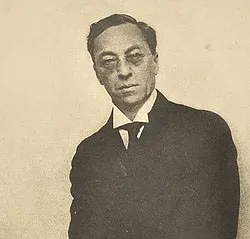
Wassily Wassilyevich Kandinsky was a Russian painter and art theorist. Kandinsky…
✦ Highlights (technique & color)
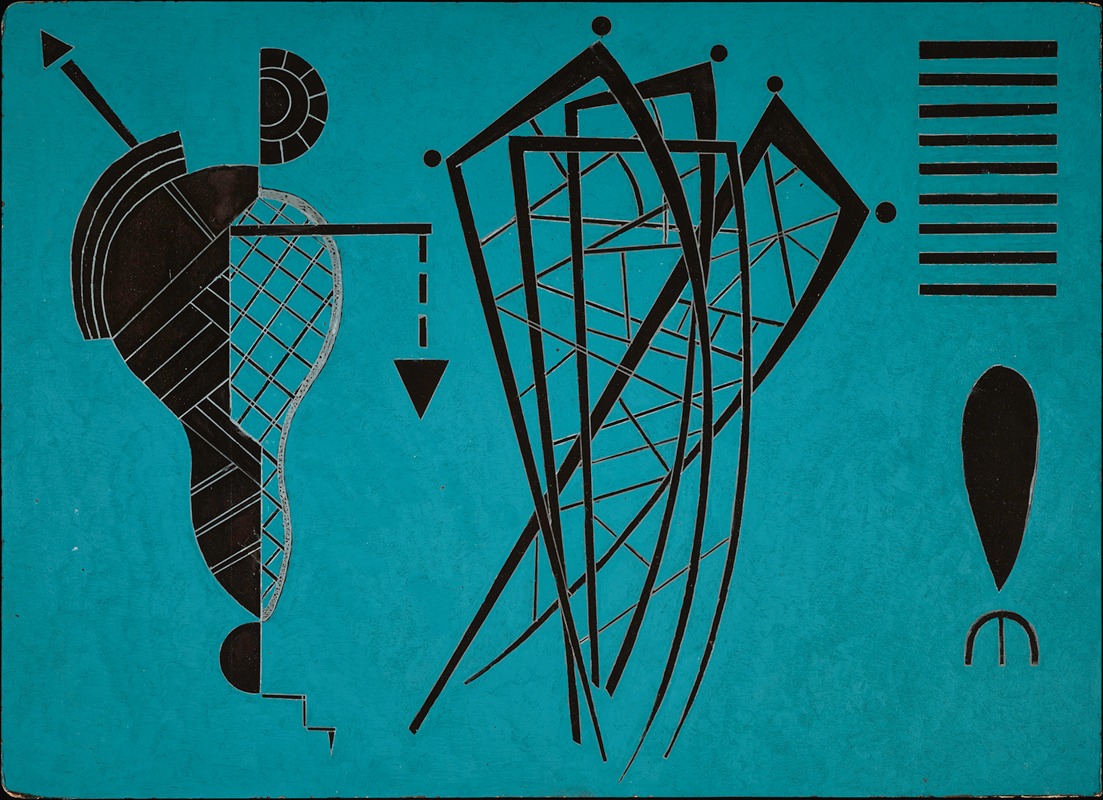
The work is characterized by a stark contrast between the vivid blue-green background and the flat, deep black. Traditional chiaroscuro—using light and shadow to create three-dimensional volume—is entirely rejected. The surreal depth of the space is built solely through the overlapping of black forms and the delicate white lines delineating the tower's structure and the mesh pattern, showcasing the refined draughtsmanship Kandinsky achieved in his final years.
✦ The setting of this painting
This painting does not depict any specific real-world landscape. Instead, it presents a flat blue-green expanse symbolizing bottomless depth and spiritual void. Divided into three asymmetrical sections, the composition evokes a scene where a curved form with a white mesh pattern, an inclined black tower, and a teardrop-shaped jet-black silhouette seem to float weightlessly in space.
✦ Historical context
Created in 1944 in France during the Second World War. Following the German occupation of Paris in 1940, art supplies had become virtually impossible to obtain after the summer of 1942. Kandinsky had retreated to the suburbs of Paris to escape Nazi oppression; amid extreme material shortages, he continued to paint using pieces of cardboard found around the city as supports.
Against a flat turquoise background, jet-black forms seem to float.
To the left lies a curved shape adorned with a white lattice pattern, while at the center, forms resembling a tilting black tower overlap.
December 1933.
Wassily Kandinsky and his wife Nina fled Nazi persecution and went into exile in France.
In Neuilly-sur-Seine, on the outskirts of Paris,
they settled in a sixth-floor apartment.
In 1940, German forces occupied Paris.
As the war intensified after the summer of 1942, obtaining art supplies in France became virtually impossible.
Kandinsky placed pieces of cardboard and simple scraps of wood found in the city onto his table.
Using them as substitute canvases, he continued to hold his brush.
Under such extreme conditions,
the colors of his paintings grew rapidly darker.
Contours turned sharper, rigidly structured.
During his final decade in Paris, he lived in isolation from society.
Even so, he continued to produce around 144 paintings and over 200 watercolors.
About 125 more words
Sign up free and enter Your Museum
Read the stories behind great paintings and music for free, in Your Museum
Your Note
Write down what this painting made you feel in your art notebook.
Please sign up to write notes.
Sign up for freeRecommended Artworks
_by_Ilya_Repin_-_%D0%9D%D0%B5%D0%B0%D0%BF%D0%BE%D0%BB%D0%B8%D1%82%D0%B0%D0%BD%D0%BA%D0%B0.webp)
Sources & references
More artists
If you find an error in this content, please let us know here
This site is protected by reCAPTCHA, and the Google Privacy Policy and Terms of Service apply.