
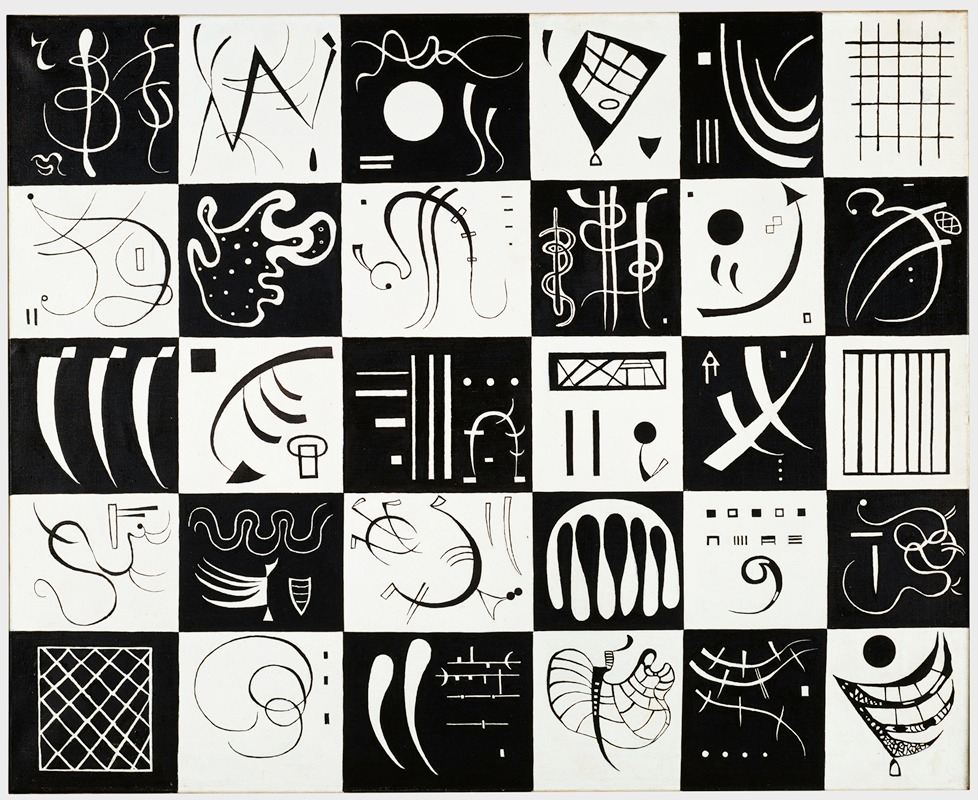
Thirty
1937
- Dimensions
- 81 × 100 cm
- Medium
- Oil on canvas
- Collection
- Centre Pompidou (Musée National d'Art Moderne)
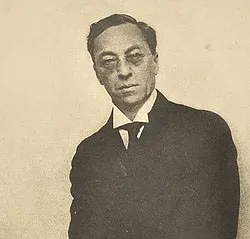
Wassily Wassilyevich Kandinsky was a Russian painter and art theorist. Kandinsky…
✦ Highlights (technique & color)
Departing from the strict geometry of his Bauhaus years, the artist shifted toward organic abstraction inspired by biomorphic forms. Alternating black and white backgrounds create a visual vibration through the reversal of positive and negative space, while the crisp black lines appear as if drawn with ink.
✦ The setting of this painting
There is no representation of concrete physical space; instead, the composition relies entirely on planar division. Divided into thirty irregular square compartments across five columns and six rows, the canvas forms a distinct microcosm where each small window seems to breathe with its own cellular and organic life forms.
✦ Historical context
In 1937, the Nazi suppression of avant-garde art reached its peak. The Degenerate Art Exhibition was held in Munich, where many of Kandinsky's works were confiscated and publicly ridiculed. Having fled to Paris in exile, he continued his artistic pursuits amidst the political turmoil.
The canvas is divided into thirty squares across five rows and six columns. Within this alternating checkerboard of black and white, mysterious symbols reminiscent of ancient hieroglyphs and microscopic organisms are arrayed.
The year was 1937, a period when catastrophic persecution reached its height for Kandinsky. In Munich, Germany, the Nazi regime staged the "Degenerate Art" exhibition. Avant-garde art was forcibly confiscated from museums across Germany, and fifty-seven of Kandinsky's works were seized. Fourteen of them were put on public display and ridiculed as the pinnacle of "degenerate art."
Relentless defamation by the Nazis and the loss of his homeland. This was the second time in the latter half of his life that he had lost all his possessions and past works. At the outbreak of the First World War in 1914, he had hurried back to Russia, entrusting his Munich studio and all his works to his former partner, Gabriele Münter. However, following their eventual separation, he was never able to recover the early works he had left in her care.
Amid such fierce adversity, Kandinsky lived a secluded life with his wife, Nina, in Neuilly on the outskirts of Paris. Though stripped of everything and faced with circumstances that demanded his silence, he refused to be silenced. Maintaining an astonishing creative drive, he exhibited work after work in Bern, Switzerland, and at museums in Paris, proving to the world that he was still thriving as a champion of the international avant-garde.
About 90 more words
Sign up free and enter Your Museum
Read the stories behind great paintings and music for free, in Your Museum
Your Note
Write down what this painting made you feel in your art notebook.
Please sign up to write notes.
Sign up for freeRecommended Artworks
_by_Ilya_Repin_-_%D0%9D%D0%B5%D0%B0%D0%BF%D0%BE%D0%BB%D0%B8%D1%82%D0%B0%D0%BD%D0%BA%D0%B0.webp)
Sources & references
More artists
If you find an error in this content, please let us know here
This site is protected by reCAPTCHA, and the Google Privacy Policy and Terms of Service apply.