
Untitled
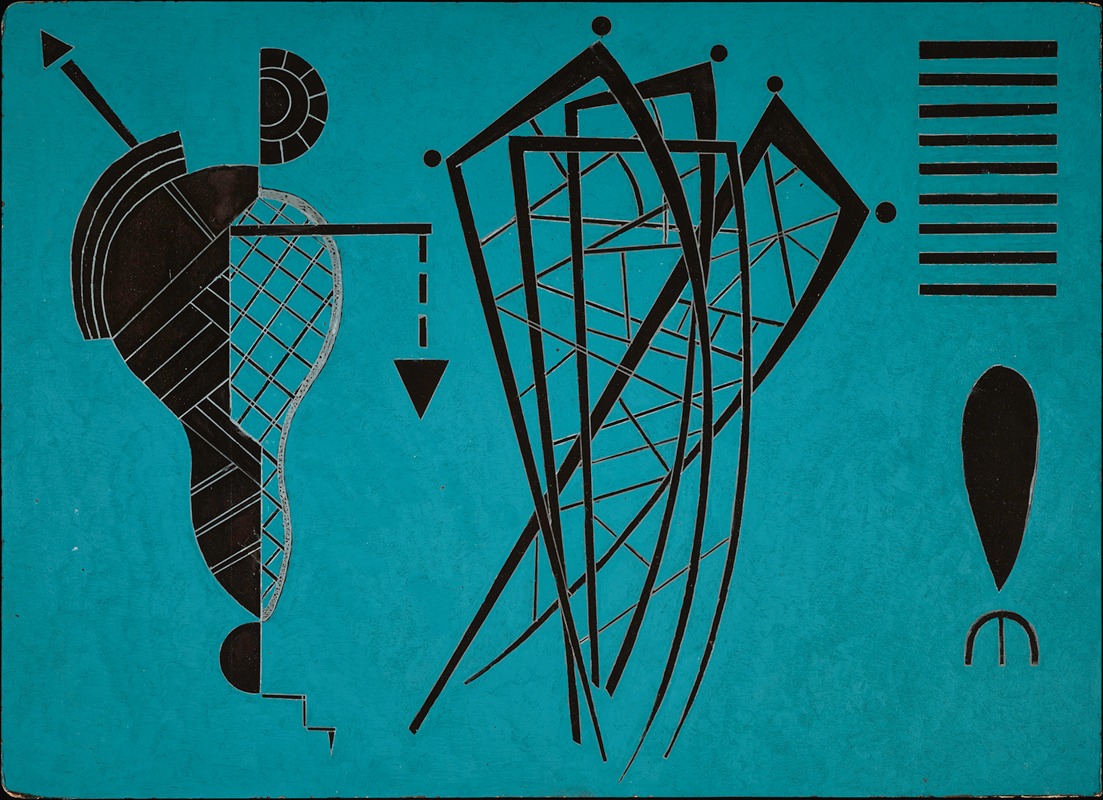
1929
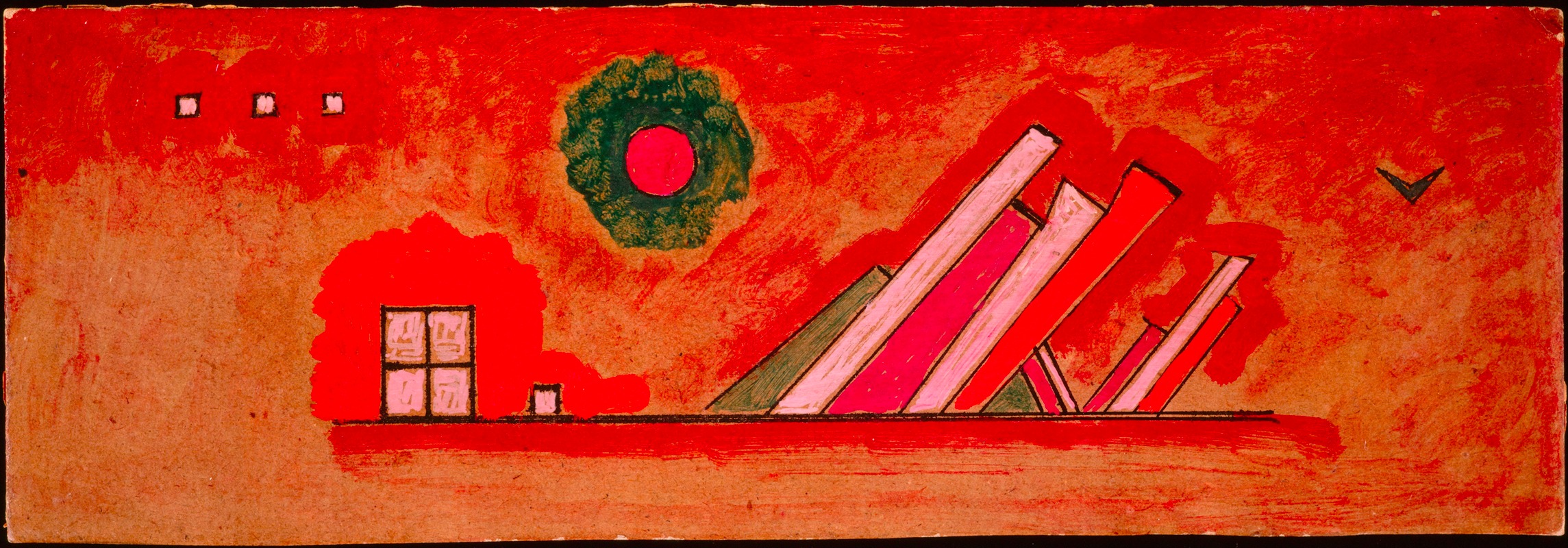
- Dimensions
- 11.4 × 33 cm
- Medium
- Oil on panel (wood or hardboard)
- Collection
- Centre Pompidou / Musée National d'Art Moderne (Paris, France)
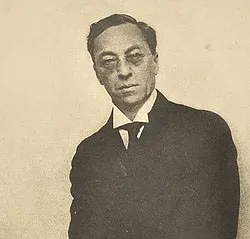
Wassily Wassilyevich Kandinsky was a Russian painter and art theorist. Kandinsky…
✦ Highlights (technique & color)
Painted on a small panel rather than canvas, the work employs a technique of applying thin, meticulous layers of oil paint. Reflecting the rigorous, rational construction of form characteristic of the Dessau period, it eliminates raw, emotive impasto brushwork. The flat planes of color harmonize with precisely rendered straight lines and arcs, highlighting an expressive logic crystallized into geometric signs.
✦ The setting of this painting
Set within an extremely elongated, panoramic composition, geometric forms such as triangles, semicircles, and straight lines are arranged alongside multiple grid patterns. On the right, a highly stylized vessel with triangular sails is depicted, accompanied by a cluster of sharp, intersecting lines resembling swords. Rather than a concrete landscape, this is a spiritual realm where symbolic imagery representing apocalyptic ruin and spiritual renewal—evoking the Great Flood and Noah's Ark—has crystallized into geometric signs.
✦ Historical context
In 1929, the Bauhaus was navigating a turbulent period following its relocation to Dessau, the departure of founder Walter Gropius, and the appointment of a new director. The world plunged into the Great Depression triggered by Black Thursday, while in Germany, the rising Nazi movement intensified its attacks on the Bauhaus. Despite this darkening social climate, it was also a historic year for Kandinsky: the American magnate Solomon R. Guggenheim began collecting his works, marking the beginning of the artist's acclaim in the United States.
An extremely elongated, panoramic composition.
On a small wooden panel measuring just 11 centimeters high and 33 centimeters wide, geometric forms—triangles, semicircles, and straight lines—along with several grid patterns are arranged in orderly precision.
At first glance, it might appear to be a cool, rational abstract painting, as if drawn with rulers and compasses.
The title, too, is simply "Untitled."
Concrete landscapes and human emotions are entirely removed, leaving only a pure arrangement of color and form.
A rigorous and rational construction of forms, characteristic of his Dessau period.
This is how the work is typically described.
Yet beneath this constellation of geometric symbols, a hidden "Noah's Ark" can be found.
Dessau, Germany, 1929.
Kandinsky, now 63, was teaching at the Bauhaus school of design, which found itself in the midst of turmoil.
The previous year, founder Walter Gropius had departed, and Hannes Meyer took over as the new director.
That same year, the Wall Street crash triggered the Great Depression.
In Germany, the Nazi movement was gaining momentum, and attacks on the avant-garde Bauhaus grew increasingly fierce.
It was a suffocating era as society plunged into darkness.
Amidst this gloom, Kandinsky quietly embedded a motif he had frequently explored in his earlier works.
It was the symbol of the Great Flood—the destruction of the world and its spiritual rebirth.
Look closely at the right side of the composition.
Can you make out the shape of a highly stylized boat with a triangular sail?
About 272 more words

Sign up free and enter Your Museum
Read the stories behind great paintings and music for free, in Your Museum
Your Note
Write down what this painting made you feel in your art notebook.
Please sign up to write notes.
Sign up for freeRecommended Artworks
_by_Ilya_Repin_-_%D0%9D%D0%B5%D0%B0%D0%BF%D0%BE%D0%BB%D0%B8%D1%82%D0%B0%D0%BD%D0%BA%D0%B0.webp)

Sources & references
More artists
If you find an error in this content, please let us know here
This site is protected by reCAPTCHA, and the Google Privacy Policy and Terms of Service apply.