
Mrs. Hugh Smith
1904
- Dimensions
- 104.2 × 81.2 cm
- Medium
- Oil on canvas
- Collection
- Private collection

Born in Italy to American parents, he spent his early years in Paris before esta…
✦ Highlights (technique & color)
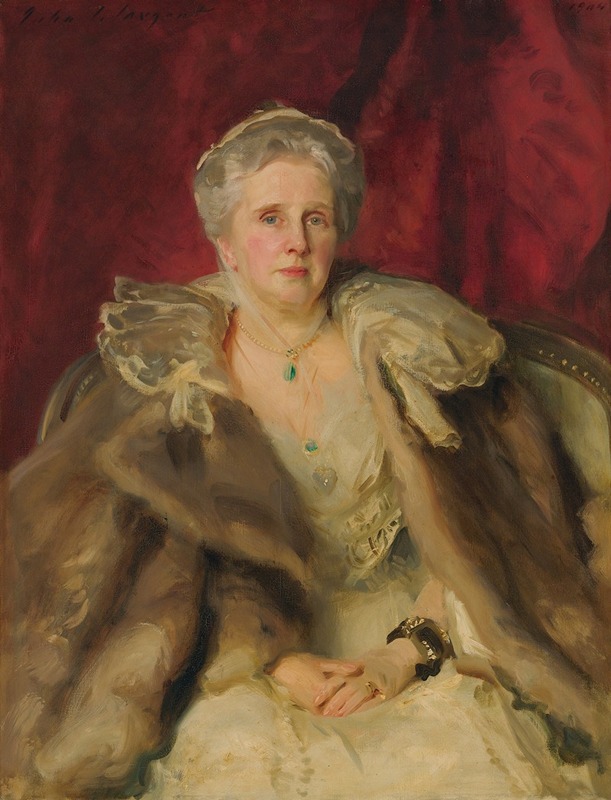
Within a restrained palette, the varying textures of different fabrics and materials are captured with astonishing realism. Notable highlights include the soft, delicate handling of the lace-trimmed white dress, the plush fur-lined wrap, and the translucent chiffon cap. In addition, the bracelet on her wrist and the pendant on her bodice are rendered with spontaneous, thick impasto brushstrokes, allowing the physical texture of the paint itself to convey the sparkle of fine jewelry.
✦ The setting of this painting
Set in Sargent's London studio, the scene features rich crimson drapery in the background, which serves as a dramatic visual backdrop to accentuate Constance's silver hair and white attire. She is seated in a French-style bergère chair, a favorite studio prop that Sargent frequently used in his portraits.
✦ Historical context
In 1904, the financial and aristocratic elite stood at the apex of British society. Constance's husband, Colin Hugh Smith, was a prominent financier who served as Governor of the Bank of England, and their son would later be elevated to the peerage as a baron, marking the zenith of the Smith family's prominence. They commissioned Sargent, the era's most sought-after portraitist, to create a work that would serve as a lasting testament to their distinguished social standing.
Against a deep crimson curtain, a silver-haired woman reclines comfortably in a French armchair. Draped in a rich, plush fur coat, a heart-shaped pendant sparkles at her chest.
Her name is Constance Adeane, who married Colin Hugh Smith in 1865. Her husband was an extraordinarily prominent financier who served as the Governor of the Bank of England.
In 1904, the Smith family—reigning at the very top of Britain’s financial and aristocratic elite—commissioned a portrait as a monumental symbol to consummate their social status.
They selected John Singer Sargent, the most sought-after portrait painter of the era, who was then at the zenith of his fame.
It was a glittering testament to success: a family with wealth and power meeting an artist at his peak. At a glance, it seems like a picture-perfect vision of enviable happiness.
In reality, however, Sargent did not want to paint this portrait.
By 1904, Sargent was deeply exhausted by his relentless schedule. He desperately wanted to retire from commercial portraiture—to escape the studio where he painted wealthy faces day after day, and devote himself to spontaneous, creative pursuits like watercolors and murals.
Yet, turning down the Smiths was no simple matter. Constance was an in-law of Madeline Wyndham, one of the sitters in Sargent’s earlier masterpiece of British high society, The Wyndham Sisters. In elite social circles, these intimate networks of family and marriage were a powerful engine for new commissions.
A formidable network, coupled with lucrative fees. The web of obligations and personal connections bound Sargent to the canvas. Unable to say no, he welcomed Constance into his London studio.
About 223 more words
Read stories of masterpieces for free
Your Note
Write down what this painting made you feel in your art notebook.
Please sign up to write notes.
Sign up for freeRecommended Artworks
.webp)

Sources & references
More artists





If you find an error in this content, please let us know here
This site is protected by reCAPTCHA, and the Google Privacy Policy and Terms of Service apply.