
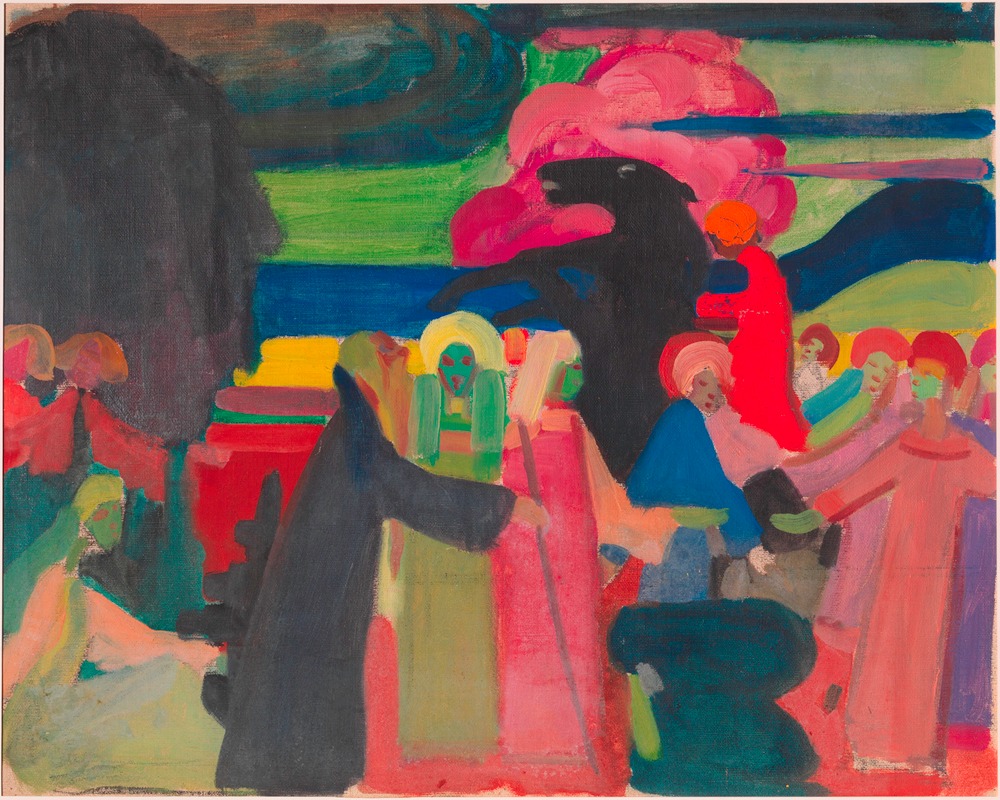
Untitled (Study for Improvisation I)
1908
- Dimensions
- 29 × 24 cm
- Medium
- Pencil, India ink, and watercolor on paper
- Collection
- Städel Museum / Lenbachhaus, Munich
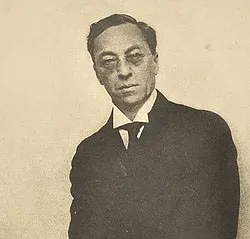
Wassily Wassilyevich Kandinsky was a Russian painter and art theorist. Kandinsky…
✦ Highlights (technique & color)
The piece is characterized by fluid masses of watercolor applied with great speed, overlaid with freely floating pen and pencil lines that avoid closed contours. Liberated from their conventional role of describing physical forms, the lines function as independent elements conveying waves of emotion.
✦ The setting of this painting
This work depicts the natural landscape of Murnau am Staffelsee, a picturesque village nestled at the foot of the Bavarian Alps in southern Germany overlooking Lake Staffel. The distant mountains, central trees, and several walking figures begin to dissolve from tangible topography into expressive forms.
✦ Historical context
In 1908, Kandinsky embarked on an extended stay in Murnau alongside Gabriele Münter and fellow artists, marking the beginning of their collaborative period. Their encounter with traditional Bavarian reverse glass painting became a decisive turning point, freeing them from representational depiction and guiding them toward pure abstraction.
A silhouette resembling a black horse rises upward, surrounded by figures clad in red, blue, and pink.
On the left stands a figure in black holding a staff.
In the background, mountains and trees appear in vivid, striking colors.
This painting is a crucial study from Kandinsky's transitional period as he moved toward pure abstraction.
It is an indispensable piece in the narrative of art history.
Dissolving concrete objects from the landscape to achieve "improvisation"—
it is generally discussed as a milestone marking his path toward this groundbreaking mode of expression.
Yet, the reason we can behold this work today is not due to the artist himself.
It survives because his former partner risked her life to protect it.
In 1904,
Kandinsky visited Murnau in southern Germany for the first time.
He was deeply captivated by its rustic, rugged landscapes and medieval charm.
Then, in 1908,
he embarked on an extended stay there alongside his partner, the painter Gabriele Münter, and other fellow artists.
Together, they began creating work collaboratively.
There, he encountered Hinterglasmalerei—the traditional Bavarian folk art of reverse glass painting.
Engaging with this primitive technique liberated him from the obligation of realistic depiction.
While heavily influenced by Fauvism, he did not stop at mere sensory excitement.
Instead, he shifted his focus toward "inner necessity"—a direct resonance with the soul.
However, in 1914, World War I broke out.
Kandinsky was forced to return to Russia.
His early abstract works and a vast collection of sketches from the Murnau period were left behind in Germany.
All of them were entrusted to Münter.
Subsequently, the era took a dark turn.
With the rise of the Nazi regime from the 1930s onward,
avant-garde art was branded as "Degenerate Art," slated for confiscation and destruction.
Kandinsky's works became prime targets.
Münter kept this vast archive hidden in the cramped basement of her home in Murnau.
These were priceless treasures of early modernism:
sketches including this very piece, as well as related works from the Improvisation series.
About 185 more words
Sign up free and enter Your Museum
Read the stories behind great paintings and music for free, in Your Museum
Your Note
Write down what this painting made you feel in your art notebook.
Please sign up to write notes.
Sign up for freeRecommended Artworks
_by_Ilya_Repin_-_%D0%9D%D0%B5%D0%B0%D0%BF%D0%BE%D0%BB%D0%B8%D1%82%D0%B0%D0%BD%D0%BA%D0%B0.webp)
Sources & references
More artists
If you find an error in this content, please let us know here
This site is protected by reCAPTCHA, and the Google Privacy Policy and Terms of Service apply.