
Sky Blue
1940
- Dimensions
- 100 × 73 cm
- Medium
- Oil on canvas
- Collection
- Centre Pompidou / Musée National d'Art Moderne, Paris
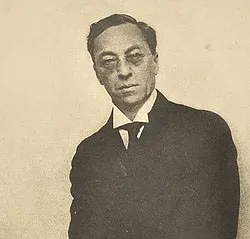
Wassily Wassilyevich Kandinsky was a Russian painter and art theorist. Kandinsky…
✦ Highlights (technique & color)
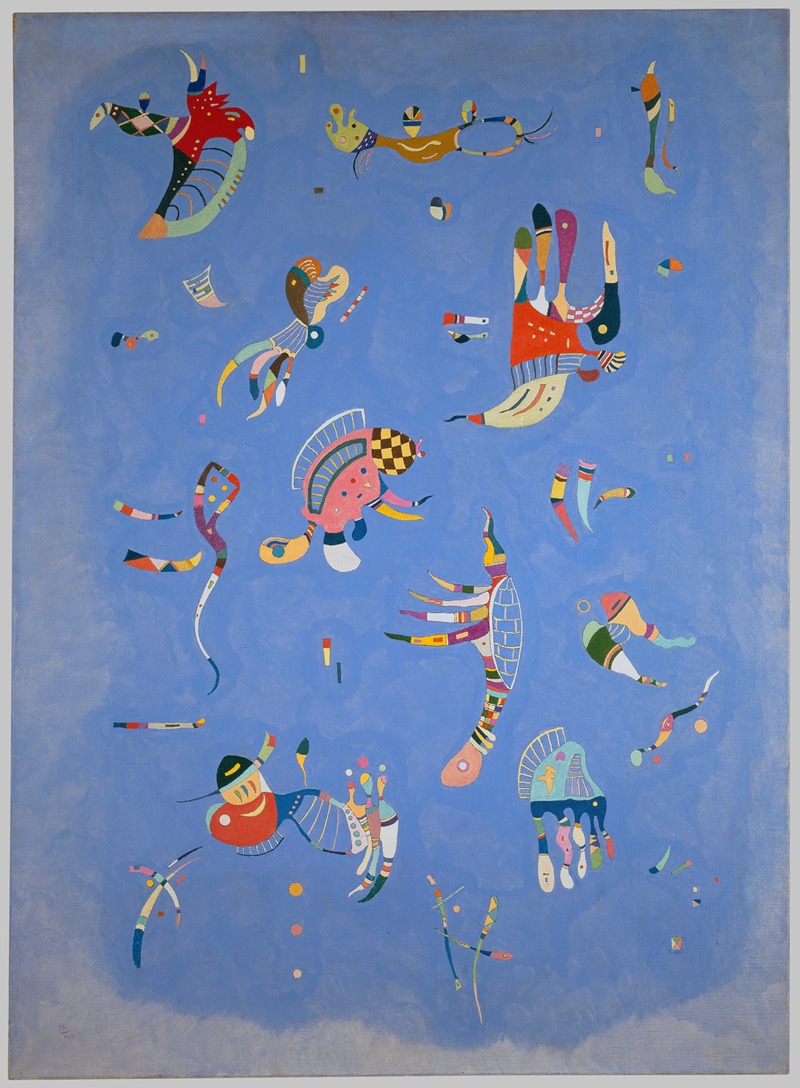
Set against a luminous, sky-blue field, flat and vibrant colors—red, yellow, green, purple, and white—are arranged without the use of chiaroscuro. Inside the hybrid, amoeba- and jellyfish-like organisms, delicate grids and linear patterns are rendered with extraordinary precision and attention to detail, seamlessly uniting boundless imagination with mathematical rigor.
✦ The setting of this painting
The setting is the studio apartment in Neuilly-sur-Seine on the outskirts of Paris, where Kandinsky spent his final years. It captures the sky stretching over the hill of Mont-Valérien in western Paris, viewed through his large studio window. The delicate, airy blue sky with milky tones is depicted as a spiritual sanctuary that transcends the harshness of reality.
✦ Historical context
Paris in 1940, during the Second World War. Following the swift German invasion, the city fell under complete occupation. Avant-garde art was suppressed, resources became critically scarce, and even obtaining painting supplies was an immense challenge. Amid the terror of air raids and profound social isolation, artists, though confined to their studios, persevered in their struggle to defend artistic freedom.
A serene, radiant world of sky blue. Floating within it are curious organisms—resembling amoebas, jellyfish, and seahorses. A light, weightless dance, entirely unbound by gravity. To the eye, it appears a bright, tranquil, dreamlike space. A fantasy painted from a peaceful mind.
Or so one might think.
In truth, this painting was born in an era of deep darkness. 1940, Paris, France, under the shadow of World War II. Following the German invasion, the city was under complete occupation. Russian-born painter Wassily Kandinsky was seventy-three years old. He had fled Nazi persecution in 1933, taking refuge here alongside his wife, Nina. In a sixth-floor apartment in Neuilly-sur-Seine—secured through the help of painter Marcel Duchamp—they lived in quiet seclusion.
In 1939, he finally obtained his long-sought French citizenship. Yet his joy was short-lived; suddenly, he found himself under the watchful eye of the occupying forces. With his art sales cut off, he lived in a state of virtual confinement. As the war intensified, acquiring painting supplies became nearly impossible. The constant fear of air raids loomed over daily life, while material scarcity pushed them to the brink.
Despair.
Amid this extreme adversity, he looked up at his window. Beyond the glass stretched Mont-Valérien, a hill to the west of Paris. There lay a uniquely delicate, atmospheric blue sky tinged with milky white. He took up his brush. Not to escape a catastrophic reality, but to construct a sanctuary for his spirit with his own hands.
About 236 more words
Sign up free and enter Your Museum
Read the stories behind great paintings and music for free, in Your Museum
Your Note
Write down what this painting made you feel in your art notebook.
Please sign up to write notes.
Sign up for freeRecommended Artworks
_by_Ilya_Repin_-_%D0%9D%D0%B5%D0%B0%D0%BF%D0%BE%D0%BB%D0%B8%D1%82%D0%B0%D0%BD%D0%BA%D0%B0.webp)
Sources & references
More artists
If you find an error in this content, please let us know here
This site is protected by reCAPTCHA, and the Google Privacy Policy and Terms of Service apply.