
La Belle Dame sans Merci (The Merciless Beauty)
1893

An English painter deeply influenced by the spirit of the Pre-Raphaelite Brother…
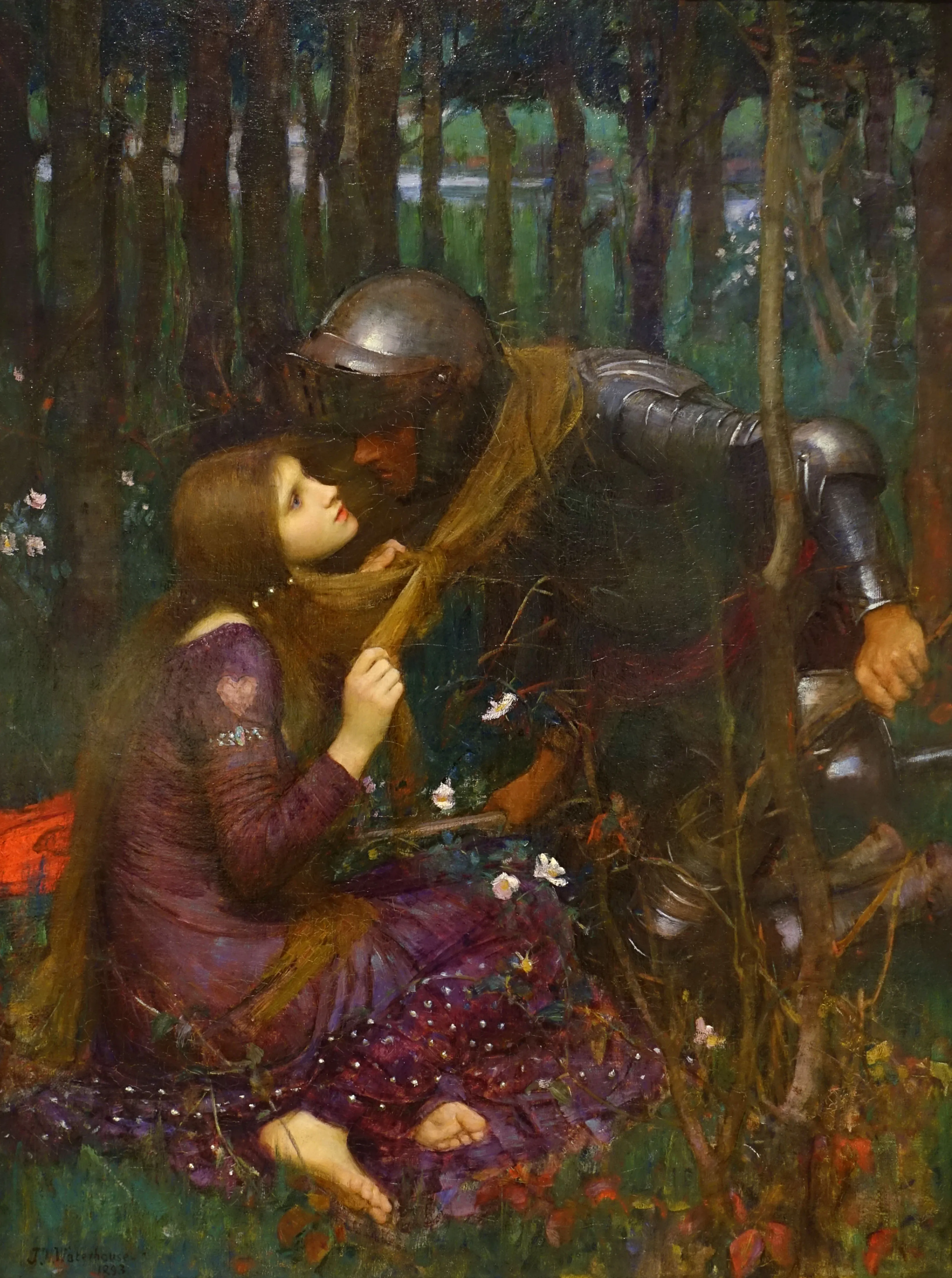
A deep, damp, late-summer forest. There stands a beautiful woman with auburn hair, clad in a luxurious wine-colored dress.
She has intricately wrapped her abundant hair around the neck of a knight in metal armor, like a serpent's trap, suffocating its prey.
The armored knight, drawn into her intense gaze, has completely lost his will. The spear, slipped from his hand and abandoned on the ground, signified the complete emasculation of his masculine power and his defeat.
This painting depicts the famous story left by the poet John Keats.
A pitiful tragedy where a knight, enchanted by a beautiful 'fairy's child,' is utterly disarmed until he loses his sanity, and is then abandoned alone in a cold, desolate wilderness.
At first glance, this appears to be a faithful rendition of that aesthetic world.
For many years, it has been said that the model for this alluring beauty was Sybil Muriel Foster, who was considered the painter's lifelong muse. Researchers also described her as such.
However, what this painting truly depicts is the deeper meaning of the 'femme fatale' myth that shook male society at the end of the 19th century.
The knight's face, sunken in shadow, is the very image of everyman, prostrating himself before the irresistible power of 'nature and beauty'.
Unlike traditional paintings, there is no image here of a 'weak woman' who loses her purity and is ostracized by society. What exists is the intense dominance of a woman who actively seizes the initiative from high-status men, reverses the power dynamic, and transforms them into mere 'palely loitering' beings.
But in reality...
Cold, primary sources, such as official UK population statistics, put an end to that myth.
Her exact date of birth was March 14, 1884. At the time this painting was unveiled in 1893, she was still just a 9-year-old girl.
Nine years old. It is impossible that she could have conveyed the overwhelming sexuality, capable of dominating men, that permeates the canvas.
So, who exactly did the painter Waterhouse depict? He did not simply copy a specific person.
He secluded himself in his studio, quietly blending various forms of female beauty in his mind.
The likeness of his wife, Esther.
The proportions of classical Renaissance paintings.
By combining these, he autonomously created a transcendent 'ideal of female beauty' that did not exist in reality.
There was a certain stubbornness on the part of the painter. At the Royal Academy Summer Exhibition of 1893, this work, which was exhibited, suffered from an unfortunate display layout.
George Frederic Watts's work, *Promises*, hung next to it. Its vivid scarlet glow overwhelmed the delicate dark reds and cool greens that Waterhouse used in his painting on the exhibition wall.
About 129 more words
Read stories of masterpieces for free
Your Note
Write down what this painting made you feel in your art notebook.
Please sign up to write notes.
Sign up for freeRecommended Artworks
.webp)
.webp)
More artists



If you find an error in this content, please let us know here
This site is protected by reCAPTCHA, and the Google Privacy Policy and Terms of Service apply.