Polonaise No. 3 in A major, Op. 40, No. 1, "Military"

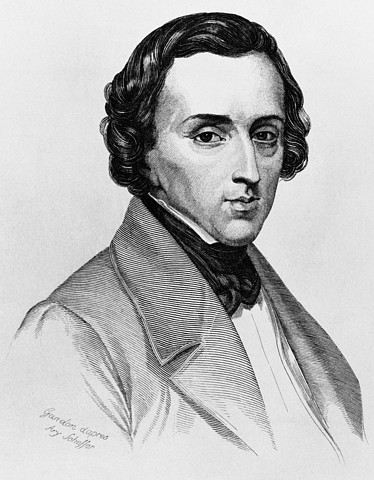
1810–1849 (Poland)
フリデリク・ショパンは、19世紀のロマン派音楽を代表するポーランド出身の作曲家であり、その生涯のほぼすべてをピアノ独奏曲に捧げた人物です。
A narrative of uncompromising struggle, portraying the lost glory of a homeland pushed to the very limits of the piano.
Listen to a recording
Polonaise No. 3 in A major, Op. 40, No. 1, "Military"
Piece Guide & Analysis
What Scene Does It Depict? — Why This Title?
Why did Chopin completely banish soft dynamics from this piece?
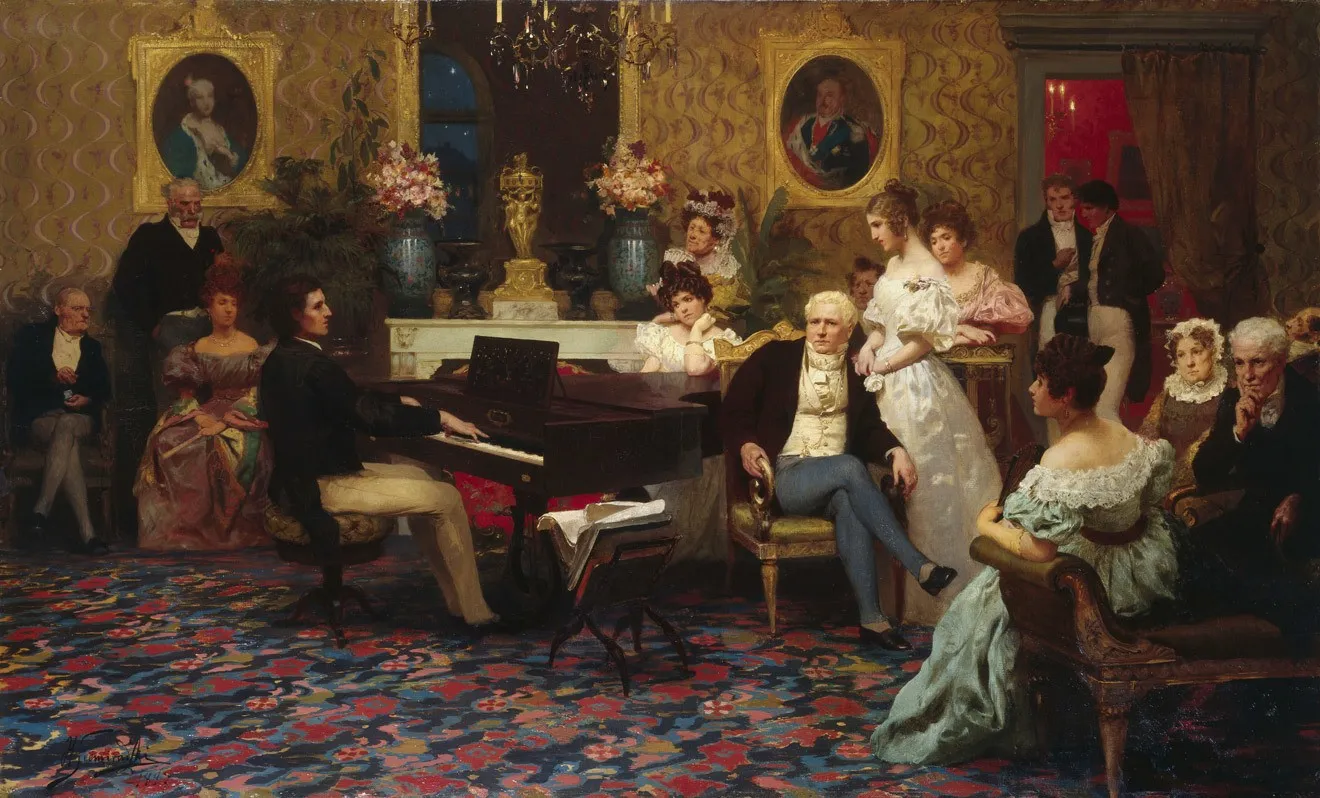
The piano keys are struck with fierce power as a resplendent fanfare rings out. A sequence of massive chords and sharp accents evokes the rapid roll of side drums. Instantly drawing listeners into the midst of a majestic march, this piece remains one of the most widely cherished of all the polonaises left by Frédéric Chopin.
The nickname "Military," now firmly established, was not coined by Chopin himself. He harbored an intense aversion to linking literary programs or concrete imagery to his abstract music, fiercely condemning the commercial titles bestowed by publishers as "foolish." Later listeners and critics began using the moniker spontaneously, inspired by the opening fanfare-like chords, the trills in the trio imitating snare drum rolls, and the heroic, marching character that drives the entire piece.
Dramatic anecdotes are often told regarding the background of this composition. In the winter of 1838, Chopin traveled to the Mediterranean island of Majorca with his lover, George Sand, to convalesce. The story goes that in his gloomy cell at the monastery of Valldemossa, unsettled by the howling storm and eerie silence, his mind fractured: he hallucinated spectral Polish knights marching out of the walls, and fled the room screaming in terror. Yet the reality was quite different.
This famous tale is in fact a dramatic conflation of the somber creative circumstances surrounding its companion piece—the Polonaise in C minor, Op. 40, No. 2—and the "Raindrop" Prelude (Op. 28, No. 15), improperly transplanted onto this A-major Polonaise by later generations. In truth, the sketches and fundamental structure of the A-major Polonaise were already completed in Paris before his departure for Majorca. It was not the product of a mental breakdown, but a work overflowing with robust, healthy energy. Amid the harsh conditions of Majorca—inclement winter weather, friction with the locals, and coughing up blood from worsening tuberculosis—Chopin completed the final revisions and fair copy, sending them to his close friend Julian Fontana. Although he had initially intended to dedicate the work to his childhood friend in Poland, Tytus Woyciechowski, he changed the dedication out of gratitude to Fontana, who had taken charge of complex publishing negotiations and everyday personal matters in Paris on his behalf.
Nor is it program music realistically depicting the charge of the Polish heavy cavalry at the Battle of Vienna in 1683, as is often claimed. Rather, it is absolute music that sublimates an abstract and noble yearning for the lost glory of his homeland into the framework of the traditional polonaise.
The Narrative — What Happens in This Piece
Though a single movement, this piece possesses an immense sonorous scale reminiscent of an orchestral tutti. Because Chopin preferred the intimacy of private salons to grand concert halls, no official record of its public premiere survives. Yet it is said that Franz Liszt, one of his greatest champions, brought the work to the grand concert stage, introducing it to the wider public through his brilliant virtuosity and overwhelming dynamism. In the United States as well, following Ludwig Rakemann's performance of Chopin's music in New York in October 1839, the piece swiftly achieved worldwide renown as a masterpiece of luminous clarity and patriotic strength.
Without any introduction, the music opens abruptly with a powerful strike of the A-major tonic chord. Propelled by the strict dance rhythm characteristic of the polonaise, the right-hand melody ascends with vigor while the left hand anchors the harmony with robust octave leaps. This majestic procession proceeds without decorative alterations, maintaining an unyielding, steely brilliance.
Entering the Trio, the key shifts to D major, introducing a more expansive, cantabile melody. Even so, the unbending pulse hammered out in the bass ensures that its noble tension never slackens. Soon, the piece plunges into a section where sharp, insistent trills—ornaments alternating rapidly between two adjacent notes—are layered into both hands. Vividly evoking the roll of snare drums, this sonority, paired with a momentary lean into the parallel key of D minor, conjures the tension of a battlefield and the foreboding of impending clash.
To fully grasp the narrative of this work, one must understand its relationship with its companion, the Polonaise No. 2 in C minor, published under the same opus 40. During Chopin's youth, the Warsaw musical world was dominated by the composer Karol Kurpiński. When the Russian Tsar was crowned King of Poland, Kurpiński composed a sycophantic "Coronation Polonaise" in homage. In the C-minor Polonaise, Chopin crafted a scathing parody—an angry rebuttal—by twisting Kurpiński's obsequious theme into a bitter minor key.
Opus 40 as a whole constitutes a diptych of Chopin's personal political statement against Russian oppression. The uncompromising "glory of the homeland" presented in the first polonaise in A major stands in stark confrontation with the "grim tragedy of reality" in the second in C minor. As the great nineteenth-century Russian pianist Anton Rubinstein famously observed, the A major is a portrait of Poland's greatness, while the C minor is a portrait of its downfall.
This music of "glory" later played a vital role in actual history. In September 1939, as Nazi Germany invaded Poland and the capital of Warsaw endured devastating aerial bombardments, Polish Radio broadcast this piece daily as a nonviolent, patriotic protest against brute force and a symbol to rally the citizenry, continuing right up until the transmitters went silent. Under German occupation, Chopin's music was banned, yet the opening phrase of this polonaise endured as a broadcast call sign for the underground resistance, becoming a universal emblem of Poland's indomitable spirit. In cinema as well, it has carried multifaceted significance across eras—from an emblem of Polish resilience in Ernst Lubitsch's To Be or Not to Be, to a distorted refrain at the close of a decadent banquet symbolizing ruin in Andrzej Wajda's Ashes and Diamonds.
Musical Analysis — A Sonorous Fortress Stripped of Soft Dynamics
What musical mechanisms generate the formidable power of this piece? Here, we examine it through the lenses of rhythm, harmony, and structural design.
First is the rhythmic landscape. The polonaise is a traditional Polish dance set in a disciplined triple meter. What is particularly remarkable in this work is the complete absence of anacrusis, or upbeat. An anacrusis occurs when a melody begins on a weak beat before the downbeat of a measure. From the opening measure to the final bar, Chopin avoids upbeats entirely, striking each phrase squarely on the downbeat. This imbues the music with an unhesitating, relentlessly forward-driving momentum.
Next, we turn to harmonic function. In the latter half of the Trio, Chopin employs a striking whole-tone harmonic progression. Following a cadence on the dominant, a sequence of chords advances in whole-step increments through B-flat major, C major, and D major. Rather than a true modulation to distant keys, this functions as a chromatic expansion of the prevailing tonality. As the chords climb like ascending steps, they create a singular sensation of expanding space, suspension, and exhilaration, showcasing Chopin's acute sensitivity to harmonic color.
The most defining structural choice, however, is the elimination of dynamic contrast. Chopin's piano music is famed for its interplay between delicate soft dynamics (piano and pianissimo) and explosive bursts of volume (forte). Yet in this piece, the contrast between stillness and motion, soft and loud, is almost entirely banished from start to finish. The score is dominated by markings such as fortissimo and energico, demanding that the performer sustain an unbroken exhilaration and physical power, ringing out the instrument with unrelenting drive.
Does this relentless barrage of strikes sound to you like pride in a homeland? Or does it echo as a solemn resolve never to let it fall?
How Context Transforms the Listening Experience
The singularity of this piece lies in its deliberate sound design, which banishes the subtle nuances of quiet dynamics—the very hallmark of Romantic piano music—in favor of an unyielding barrage of forte and beyond. Rejecting the sighing rubato and sentimental expressions cherished by the salons of his day, Chopin instead hammers out an unshakeable will in solid blocks of sound, setting this work apart from the rest of his oeuvre.
Without this context, one might easily pass over the A-major Polonaise as merely a bright, patriotic march. But when one learns of its pairing with the Polonaise No. 2 in C minor and the hidden dialogue with Karol Kurpiński, a striking truth emerges. The C-minor Polonaise was penned as a furious parody of a contemporary composer who bowed to imperial power, and this A-major work stands as its counterpart. These unclouded sonorities of triumph are not mere nostalgia for the past, but a blindingly brilliant foil engineered to bring the cruel tragedy of reality into sharp relief.
One might initially hear it as a dazzling and heroic military march. Yet, upon discovering its tragic twin and its radical acoustic design that permits no soft dynamics, the piece transforms into a chronicle of uncompromising resistance—a spiritual fortress never to be surrendered.
Highlights — Where and What to Listen For
Let us trace the formidable architecture and narrative of this piece through the unfolding music itself.
Opening of the First Section: The Striking of the Majestic Main Theme
Without preparation or preamble, the piece opens with an explosive stroke of the A-major tonic chord. Riding the characteristic rhythm of the polonaise, the right-hand melody strides upward like ascending steps, while the left hand builds a dense foundation of octave leaps. Stripped of all superfluous ornamentation, this austere and dignified march seizes the listener with commanding force.
First Section: Bass Flourishes Evoking Military Bugles
Following the main theme, a responsive secondary idea emerges. At the end of each phrase, a brisk decorative figure cascades into the lower register. This brief descent rings out with the vivid realism of a military bugle call, giving the music a rich, three-dimensional depth.
Latter Half of the Trio: Snare Drum Rolls and the Foreboding of Battle
After modulating to D major and singing out a slightly more lyrical melody, the music abruptly takes on an ominous cast. Dense chords in both hands are persistently laced with sharp trills. These trills vividly depict the roll of snare drums; together with a tilt toward the dark sonority of D minor, they conjure an unmistakable sense of battlefield tension and imminent conflict.
Does this relentlessly reiterated drumming sound to you like a triumphal victory parade? Or do you hear in it the approaching footsteps of war?
Conclusion of the Third Section: An Uncompromising, Sustained Fortissimo
Emerging from the Trio, the opening A-major theme returns. By convention, the repeat signs are bypassed here, driving straight toward the finish. Stripped of dynamic contrast from first measure to last, the music maintains its robust tempo and sustained fortissimo, charging through in a single breath to the final chord. Allow yourself to absorb this overwhelming release of energy to the very end.
Your Note
Write down what you felt and learned from this piece in your art notebook.
Please sign up to write notes.
Sign up for freeSources & references
- en.wikipedia.org
- www.chopincompetition.pl
- chopin.nifc.pl
- www.loc.gov
- www.chopin.pl
- chopin.nifc.pl
- www.youtube.com
- chopin.nifc.pl
- www.nfm.wroclaw.pl
- chopin.nifc.pl
- chopin.nifc.pl
- devchopin.squarespace.com
- www.henle.de
- www.halleonard.com
- www.all-sheetmusic.com
- www.allmusic.com
- www.youtube.com
- www.hyperion-records.co.uk
- polishmusic.usc.edu
- www.chopin.pl
Read stories of masterpieces for free
This site is protected by reCAPTCHA, and the Google Privacy Policy and Terms of Service apply.
If you find an error in this content, please let us know here