Piano Sonata No. 2 in B-flat minor, Op. 35 "Funeral March"
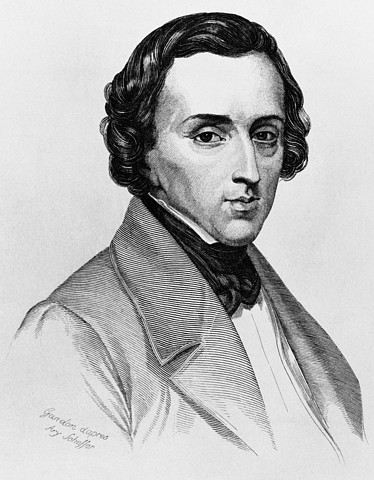
1810–1849 (Poland)
フリデリク・ショパンは、19世紀のロマン派音楽を代表するポーランド出身の作曲家であり、その生涯のほぼすべてをピアノ独奏曲に捧げた人物です。
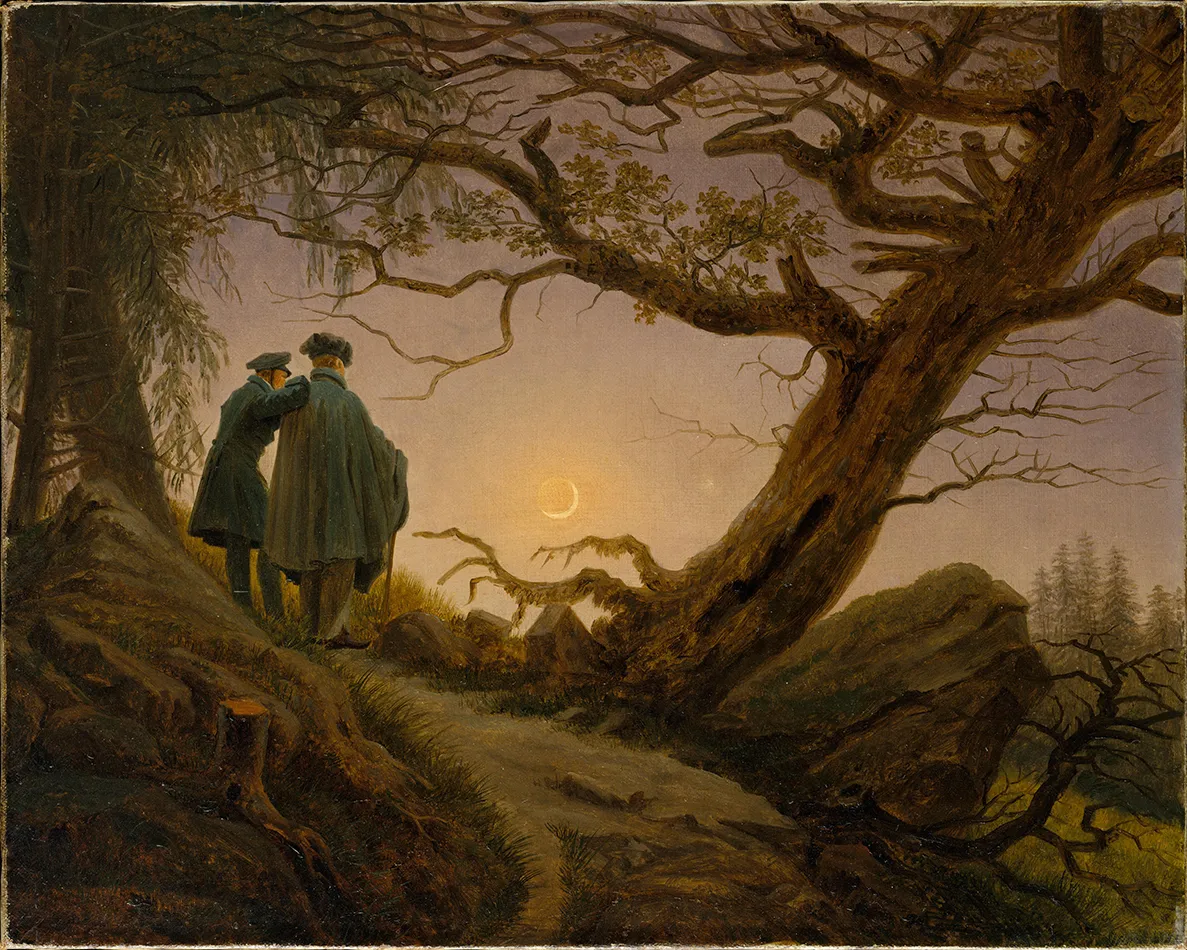
A poignant lament for a lost homeland, and a tale of nothingness reached by a mind pushed to the brink. What lies ahead beyond those heavy footsteps?
Listen to a recording
Piano Sonata No. 2 in B-flat minor, Op. 35 "Funeral March"
Piece Guide & Analysis
What Scene Does It Depict? — Why This Title?
What lies ahead beyond those heavy footsteps?
Mention Chopin's "Funeral March," and almost anyone will recall that dark, somber melody heard at least once in their life. Yet do you know whose death this piece was actually written to mourn?
In fact, this work bears no dedication to any patron or acquaintance, nor was it written on commission. It suggests that Chopin himself regarded this music as an intensely personal, profound confession. On the autograph manuscript where the trio (middle section) of the third movement, "Funeral March," was sketched, a deeply symbolic date is inscribed: "November 28, 1837." This was the eve of the anniversary of the November Uprising (1830), an event that sealed the fate of Poland.
At the time, the Polish émigré community in Paris observed a tradition of solemn commemoration on the eve of such historical and religious anniversaries, and Chopin himself frequently improvised at these commemorative gatherings. In other words, this piece was born not from the death of a specific individual, but from a profound mourning for a lost homeland and Chopin's own poignant sorrow over the tragic fate of his country.
Between late 1838 and 1839, Chopin traveled to the Spanish island of Majorca with his lover, George Sand, and her children, seeking to convalesce from tuberculosis and focus on composition. However, the stay turned disastrous due to torrential weather, squalid lodgings, and hostility from the locals after Chopin began coughing up blood, leaving his mind haunted by visions of death. Barely escaping with his life back to mainland France, Chopin spent the summer of 1839 at Sand's country estate in Nohant, in central France. As he regained his emotional stability, he conceived the other three movements to frame the previously composed "Funeral March." Thus, this monumental sonata took its complete shape.
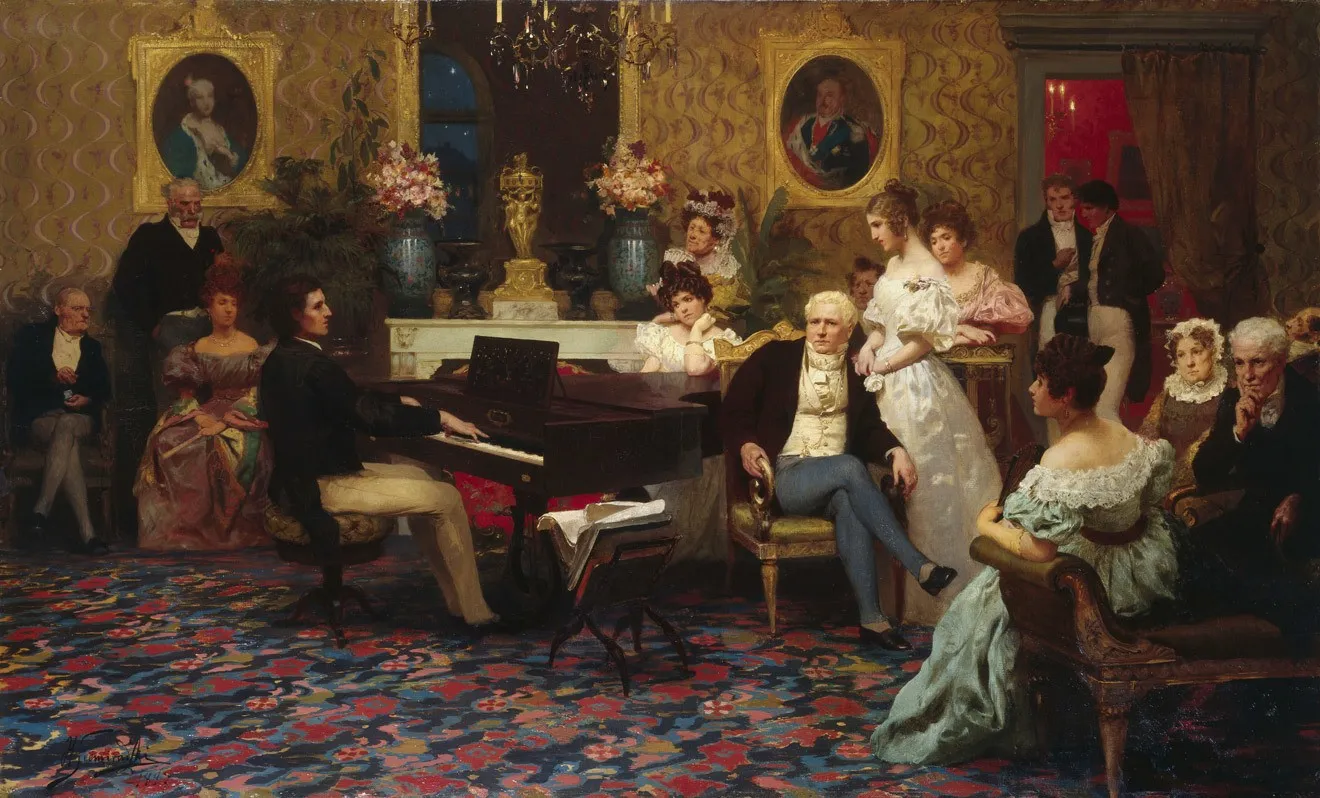
An episode testifying to Chopin's extreme mental state occurred in 1848 during a performance of this sonata in a British salon, when he abruptly stopped playing and fled the stage. In a letter he later wrote to Sand's daughter, he vividly confessed to a hallucinatory experience, recounting how, while playing, he saw "those eerie apparitions that had once appeared on that night at the monastery in Majorca" crawling out from inside the piano.
Furthermore, while the entire sonata is often called the "Funeral March," Chopin himself never officially gave the whole work this moniker. In a letter to a friend, he merely reported in practical terms: "I am writing a sonata in B-flat minor containing the march you know." However, because the third movement bore the official tempo and character marking "Marche funèbre" upon publication, its intense tragedy came to symbolize the entire work, firmly establishing the nickname "Funeral Sonata" for posterity.
The Narrative — What Happens in This Piece
This sonata is cast in the classical four movements, yet within them unfolds a dramatic narrative that boldly transcends conventional boundaries.
The first movement opens with a somber introduction before plunging into a main section filled with breathless agitation. Here, the motif presented at the outset permeates the music, transforming into stormy, surging melodic lines. In the subsequent second-movement Scherzo, rapid octave leaps unleash an almost violent energy, yet the middle section turns completely to reveal a gentle, serene melody reminiscent of a waltz or a nocturne. It ends with echoes of the middle section, leading straight into the heart of the work: the third movement.
In the third movement, "Funeral March," low notes toll like funeral bells of a church as the funeral cortege advances with heavy steps. Along the way, fierce chords are struck as if voicing an outcry and rage against the cruel march of fate, but upon entering the trio, a pure, defenseless song resounds as though liberated from gravity itself.
The finale, the fourth movement, completely banishes melody and any distinct theme; both hands trace the exact same notes in unison, sweeping past in a rapid whirlwind. While this fourth movement is often described as depicting "the wind howling over the gravestones after the burial," this is merely an image conjured by later pianists. Chopin himself vehemently detested projecting literal pictorial scenes onto his music, merely remarking in a letter: "After the march, the left hand and the right chatter in unison." It was a pure acoustic experiment—and perhaps an epilogue of sheer void after everything has vanished.
With its overwhelming melody, this third movement is also one of the most frequently arranged pieces in classical music history. In 1932, the English composer Edward Elgar arranged it for a massive full orchestra that included contrabassoon, harp, and an expansive percussion section. Transposed from the original B-flat minor to C minor, it was endowed with a symphonic, solemn grandeur.
Furthermore, as a utilitarian symbol of death, it has been played as official mourning music at the state funerals of figures such as John F. Kennedy, Winston Churchill, and successive leaders of the former Soviet Union. At the same time, it is frequently used in animated television shows and comedy films as stereotypical background music when a character meets a comically disastrous end—a singular masterpiece that spans the extraordinary extremes between solemn state ceremonies and popular entertainment.
Musical Analysis — The Acoustic Space Crafted by Tolls and Footsteps
When this sonata was published in 1840, its groundbreaking content was embraced by the public, yet it provoked fierce rejection from conservative critics. Robert Schumann harshly remarked: "To call this a sonata is a mere jest; he has simply bound together four of his wildest children and smuggled them in under that name." Yet in the twentieth century, scholars revealed that these seemingly disconnected movements are in fact subtly and intricately unified by minute motifs, such as the minor third and the descending seventh. Here, let us focus especially on the harmony, rhythm, and acoustic palette drawn from the piano in the third movement.
Harmonic Function: Funeral Bells and Liberation from Gravity
In the main section of the third movement, an octave on B-flat—the tonic of B-flat minor—resonates relentlessly in the lowest register of the left hand from the very beginning. This is a technique known as basso ostinato, an obstinately repeating bass pattern. It simulates the physical resonance of a church's funeral toll on the piano, confronting the listener with the inescapable fate of death. Toward the end of the main section, chromatic dissonances—such as strings of diminished sevenths crafted deliberately to create instability—are deployed to express an outcry and fury against destiny in harmonic terms.
Yet entering the trio, the music modulates to D-flat major within a single bar, without a single transitional chord. The texture shifts from the cavernous low register to soft arpeggios in the middle and upper registers, instantly whisking the listener away to a world of silence. Here, an exceptionally simple functional harmony is preserved, sustaining an innocent beauty that seems to resist any artificial expressive embellishment.
A Shift in Rhythmic Scenery: The Cessation of Steps
The main section of the third movement is structured around a traditional dotted rhythm. The repetition of this stereotyped rhythmic pattern coldly recreates the heavy, measured tread of the funeral cortege, step by deliberate step.
However, upon entering the trio, this dotted rhythm vanishes entirely. Above even eighth-note broken chords in the left hand, the right hand begins to sing a slow, expansive melody. This shift in rhythm creates the illusion that earthly time has ground to a halt, leaving one drifting through infinite space. As the dotted rhythm dissolves into this serene melody, do you see the light of heavenly salvation? Or does it sound to you like a fleeting vision of lost everyday life, envisioned by a mind pushed to extremes?
Instrumental Texture and Density: The Piano as a Resonating Body
Chopin wrote meticulous pedaling indications into his scores to draw the maximum physical resonance from the piano. He often indicated keeping the sustain pedal fully depressed, which on a modern concert grand piano causes excessive blurring; yet on the early 19th-century instruments Chopin favored, this was an indispensable technique to generate a radiant halo of rich overtones.
In contrast, in parts of the third movement's trio, he deliberately asks for no pedal, requiring the notes to be sustained purely through finger touch. This creates a stark textural contrast. His unique approach to treating the piano not as a mere percussion instrument, but as a sophisticated soundboard and resonator, underpins the profound sonority of this work.
How Context Transforms the Listening Experience
An intriguing aspect of this work's performance history is the "mystery of the repeat sign"—namely, where the exposition of the first movement should be repeated from.
For many years, it was standard practice to repeat only from the fast main section, but discrepancies in notation exist among the various first editions and copyist manuscripts left by Chopin.
In recent years, the interpretation that Chopin truly intended the repeat to begin from the very opening of the somber introduction has gained considerable ground, leading different performers to shape distinct musical dramas.
It is also crucial to note that this revolutionary sonata took Beethoven as a model. Chopin used Beethoven's Piano Sonata No. 12—a piece he loved to play and often assigned to his students—as a direct blueprint. Beethoven's No. 12 likewise defied convention by opening with a theme and variations, placing a scherzo second, a funeral march third, and concluding with a rapid toccata-like movement. Deeply impressed, Chopin radicalized this structure even further, translating it into the Romantic idiom. Moreover, the complex harmonic progressions heard in the development of the first movement were the fruit of his exhaustive study of Bach's counterpoint.
One might easily listen to this work assuming it was written solely out of sentimental emotions—a sweet romance with George Sand or dread of impending death. Yet knowing it is the culmination of rigorous musical experiments built with a cool, lucid intellect through exhaustive studies of Bach's counterpoint and Beethoven's architectural designs, the piece transforms into a testament to an artist's fierce willpower: one who refused to drown in emotion, sublimating even the most extreme mental turmoil into a flawless acoustic architecture.
Highlights — Where and What to Listen For
Here are several key moments that capture the essence of this monumental sonata.
Movement 1: From the Somber Introduction to the Agitated Main Section
At the opening, heavy, sinking chords resound: the descending-seventh motif that governs the entire sonata. From there, the music plunges abruptly into a breathless tempo. Riding over the surging accompaniment of the left hand, the right hand scales upward as if spurred by frantic agitation.
Movement 2: Violent Leaps and a Serene Trio
In the main section of the Scherzo, a succession of rapid octave leaps unleashes an explosion of raw energy. Yet entering the middle section, as though wandering into another realm, a leisurely waltz-like melody unfolds. This dramatic swing between emotional extremes shakes the listener to the core.
Movement 3: Funeral Bells and the Inexorable Tread
Now begins the "Funeral March." In the lowest depths of the left hand, B-flat octaves toll ceaselessly like church bells. Above them, the right hand plays a somber, dotted-rhythm melody. Step by relentless step, the cold, measured tread confronts us with the inescapable weight of mortality. Capitalizing on the qualities of the period pianos Chopin cherished, a wash of rich overtones floods the space.
Movement 3: The Trio Where Time Stands Still
The somber tread of the cortege suddenly breaks off, and the music shifts without warning into a tender D-flat major. Supported by even arpeggios in the left hand, the right hand weaves an infinitely pure, vulnerable song. Freed from earthly gravity, it is a realm of hush where time itself seems suspended. Is this exquisite melody merely a fleeting dream glimpsed amidst despair?
Movement 4: An Eerie, Melodiless Epilogue
As the final somber chords of the third movement fade away, the fourth movement erupts without a moment's pause. Here, devoid of melody and harmony, both hands trace the exact same line in unison, unleashing a rapid tempest. With almost no dynamic contrast, only an eerie rustling rushes past. In this chilly swirl of notes stripped of emotion, do you hear the wind howling through a graveyard? Or is it the sound of the void left behind after total collapse?
Finally, with a single, savagely struck chord, this epic narrative slams shut. What lies ahead beyond those heavy footsteps, as asked at the outset, might not be peaceful redemption after all, but this overwhelming abyss of nothingness.
Your Note
Write down what you felt and learned from this piece in your art notebook.
Please sign up to write notes.
Sign up for freeSources & references
Read stories of masterpieces for free
This site is protected by reCAPTCHA, and the Google Privacy Policy and Terms of Service apply.
If you find an error in this content, please let us know here