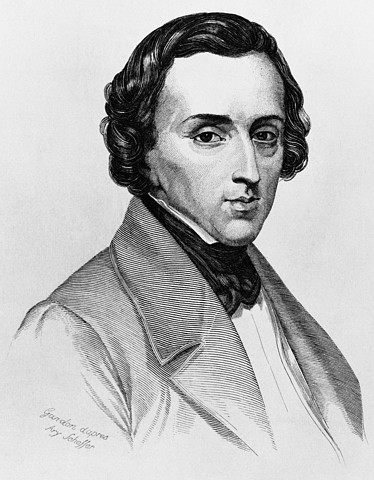
1810–1849 (Poland)
フリデリク・ショパンは、19世紀のロマン派音楽を代表するポーランド出身の作曲家であり、その生涯のほぼすべてをピアノ独奏曲に捧げた人物です。
— A heavy, unwavering march forward amidst a howling tempest —
Listen to a recording
Étude No. 23 in A minor, Op. 25, No. 11 "Winter Wind"
Piece Guide & Analysis
When we listen to this piece, are we truly hearing a "cold winter wind"?
A quiet question echoes from the darkness, immediately followed by a torrential flood of sound that seems to swallow everything whole. Swirling with overwhelming energy and tragic pathos, this composition is widely loved and known as the "Winter Wind" (or Kogarashi in Japan). A common myth suggests that Chopin was inspired by the sound of freezing winter winds howling outside his window in Paris, writing the piece as a musical depiction of nature. In reality, however, this is entirely a later fabrication.
Chopin deeply despised having his works reduced to specific, picturesque images. Throughout his life, he consistently gave his sheet music only the objective, formal title of "Étude" (Study). Literary titles like "Winter Wind" were arbitrarily attached by publishers and critics after publication as a marketing strategy and a way to make the piece more accessible, attempting to capture its explosive energy and the undulating chromaticism of the right hand.
So, where did the true passion embedded in this piece come from? In the mid-1830s, when the composition was underway, Chopin was living in Paris as a de facto exile after an uprising in his native Poland was crushed by armed force. He carried deep sorrow and fierce rage. Furthermore, in his private life, his secret engagement to his childhood friend, Maria Wodzińska, was collapsing due to her family's opposition, and he himself had fallen severely ill, weakening to the brink of death. The dark, dramatic expression of emotion in this piece, and its extreme states bordering on madness, may have been deeply connected to this physical and mental crisis.
The Narrative — What is Happening in This Piece?
This composition unfolds a grand musical drama that goes far beyond a mere finger exercise. The curtain rises with a deeply silent, introspective question. However, this tranquility does not last. Suddenly, the right hand unleashes a stormy, tempestuous motif that sweeps across the entire keyboard, while the left hand roars the primary melody with a heavy, marching tread. It feels like the sheer force of human will desperately trying to push forward through the irresistible, muddy torrent of fate.
As the piece progresses, the music intensifies its sense of urgency. The tonality shifts rapidly, floating between distantly related harmonies, elevating the internal conflict to its absolute limit. Eventually, the rapid motion—previously confined to the right hand—spills over into the left, plunging the listener into a thrilling scene where both hands intertwine like a turbulent flood. When the initial, heavy melody finally returns, its resonance is far thicker than before, acquiring a power reminiscent of a full orchestral tutti. Finally, after a relentless, agonizing extension that tricks the ear into thinking it will end but doesn't, both hands synchronize completely, rushing down the keyboard in one breath, and the piece is severed by a succession of majestic chords.
This overwhelming sense of scale and drama has profoundly inspired artists of later generations. In the early 20th century, the pianist and composer Leopold Godowsky left behind an astonishing transcription that demands the same—or even greater—transcendental technique from the left hand as the horrific right-hand original. This was not a mere technical circus; it was a pursuit of the piano's polyphonic limits, making one hand simultaneously play the right-hand chromatic accompaniment and sing the left-hand march theme in counterpoint.
Its power remains alive and well in modern pop culture, too. In the film Green Book, it is used in a symbolic scene where the protagonist begins playing this piece with flawless technique in a Southern bar steeped in racial segregation, instantly silencing the noisy crowd. In the anime Your Lie in April, it is effectively used as an insert song when characters confront their limits and trauma, brilliantly expressing the psychological tempest raging within.
The history of how this piece has been performed is a grand narrative in itself. From the 19th to the early 20th century, romantic performances prioritized dramatic emotion over technical precision, blending the right-hand chromaticism like a "fog of sound," as championed by Alfred Cortot. In the late 20th century, however, Maurizio Pollini established an objectivist approach, eliminating emotional exaggeration and striking every single note with equal, metallic resilience. Today, interpretations like those of Yulianna Avdeeva—which restrain the pedal to intelligently highlight the polyphonic structure lurking behind the right hand—are becoming mainstream. With the changing of eras, the different faces of this piece continue to be drawn out.
Musical Analysis — The Left-Hand March Piercing the Right-Hand Storm
The unique acoustic space of this piece is built upon meticulously calculated structure, harmony, and a design that pushes the instrument's characteristics to their absolute limits. Let's unravel these secrets from three perspectives.
About 1,107 more words

Sign up free and enter Your Museum
Read the stories behind great paintings and music for free, in Your Museum
Your Note
Write down what you felt and learned from this piece in your art notebook.
Please sign up to write notes.
Sign up for freeSources & references
- www.youtube.com
- www.youtube.com
- en.wikipedia.org
- cantorion.org
- en.wikipedia.org
- en.wikipedia.org
- www.henle.de
- interlude.hk
- www.chopin.pl
- www.youtube.com
- muswrite.blogspot.com
- chopin.nifc.pl
- www.classicalconnect.com
- www.reddit.com
- fr.wikipedia.org
- www.pianostreet.com
- thesalonmusicblog.wordpress.com
- repositories.lib.utexas.edu
- people.ece.ubc.ca
- ja.wikipedia.org
This site is protected by reCAPTCHA, and the Google Privacy Policy and Terms of Service apply.
If you find an error in this content, please let us know here