
 日本語 (JA)
 English (EN)
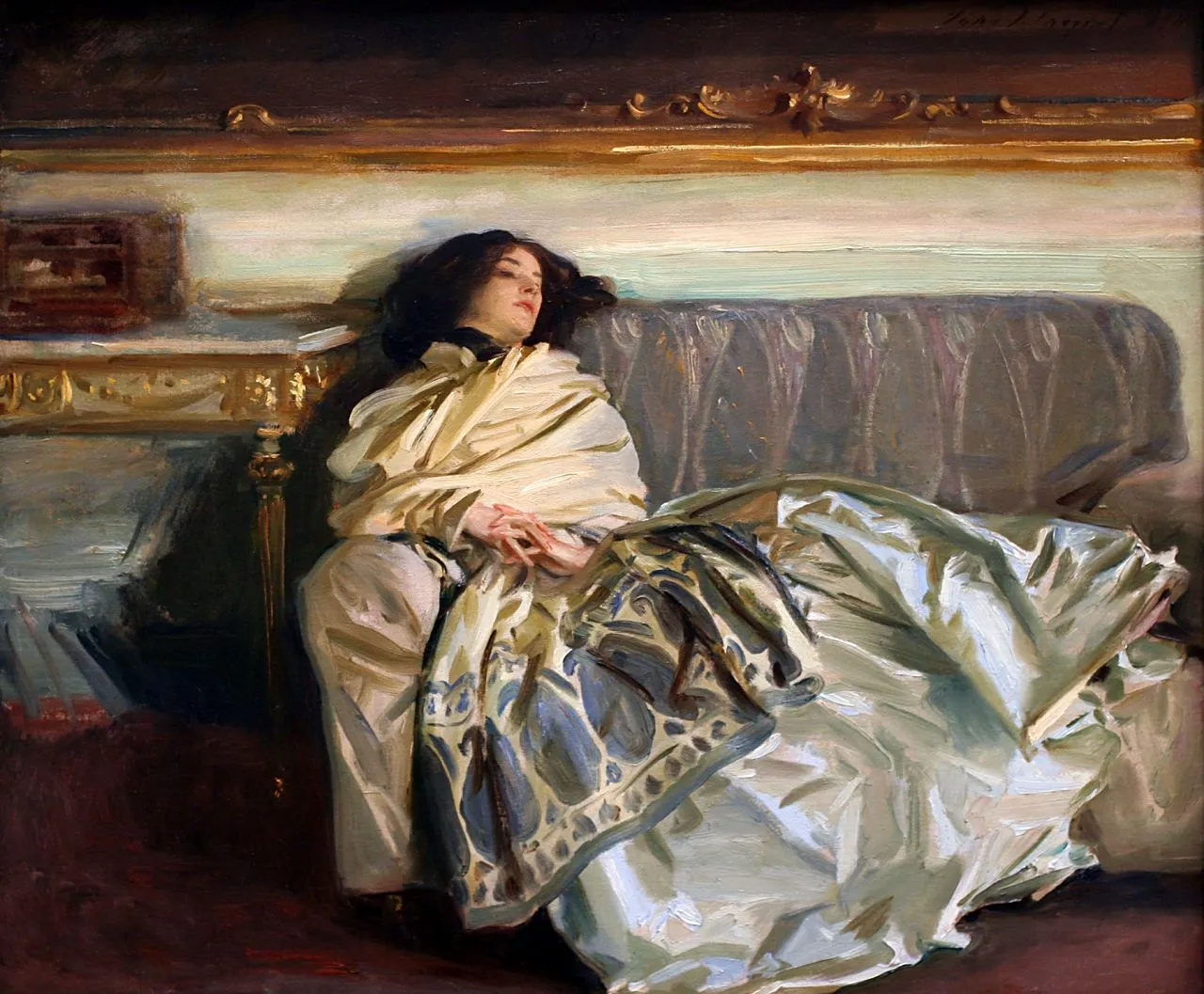
- Dimensions
- 63.8 × 76.2 cm
- Medium
- 油彩、カンヴァス
- Collection
- ワシントン・ナショナル・ギャラリー
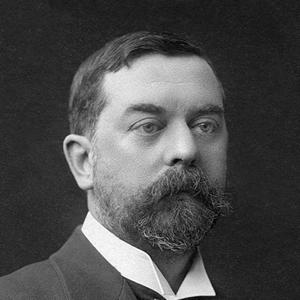
Born in Italy to American parents, he spent his early years in Paris before esta…
裕福な依頼客の虚飾に応じる肖像画ビジネスに嫌悪感を抱き、金銭や要望に縛られない完全な自主制作として、純粋な造形的探求と自由な色彩表現を追求した。
✦ Highlights (technique & color)
画面右下半分を占めるサテンスカートのボリュームと対角線状のドレープが視線を誘導し、左上のモデルの顔へと導きます。サテン生地の陰影には単なる黒やグレーではなく、透明感のあるビリジャンやプルシアンブルー、冷たいラベンダーやマゼンタなどの彩度の高い補色が並置され、玉虫色の光沢感を表現しています。
✦ The setting of this painting
スイスのアルプス地域(シンプロン峠周辺)にある高級ホテルの客室。午後の柔らかい琥珀色の光が差し込む中、深緑色の豪華な布張りソファや暗色の木製家具、大型の金縁鏡が配置された空間。
✦ Historical context
1911年前後、ヨーロッパのベル・エポック文化が最後の輝きを見せていた時期。写真技術の高度化に伴い、絵画は単なる記録から主観的な感覚や色彩自体の美的価値の追及へとシフトしていました。
A young woman sinks deeply into a plush, dark green upholstered sofa. Her voluminous ivory-white satin skirt spills outwards, and an oriental paisley cashmere shawl drapes in generous folds from her shoulders to her waist. She lies completely limp, in an unguarded posture. Her eyes are cast down, never meeting the viewer's gaze. She simply drifts in the quiet slumber of the afternoon. In this picture, John Singer Sargent found in her nonchalant repose the "true freedom" he had long yearned for himself.
Escape from the Portrait Business
By the late 1900s, Sargent reigned as an immensely popular portraitist among the British and American upper classes. Yet inside, he was deeply exhausted. He had developed a profound distaste for continually catering to the vain demands of wealthy patrons. In letters to friends, he went so far as to call his portrait practice a "pimp's profession," laying bare his anguish. Eventually, he publicly declared that he would never paint another high-society portrait and resolved to stop accepting new commissions altogether.
What he sought was pure artistic exploration, free from financial gain and the self-serving whims of clients. Nonchaloir (Repose) stands as a monumental work created during this break from worldly obligations, painted entirely on his own terms. The setting was a summer retreat in the Alps with close family and friends. Surrounded by crisp mountain air and unhurried hours, the artist's brush began to reclaim its original brilliance.
A Niece at Rest in a Hotel Room
In a room of a luxury hotel in the Swiss Alps, soft, amber afternoon light filters in as Sargent sets up his canvas. Thrown across the sofa before him is Rose-Marie, his sister's second daughter and the niece he doted on unconditionally. Seventeen at the time, she surrendered herself to deep rest, unpretentious and completely natural.
Rose-Marie was remarkably supple-jointed, with a curious habit of deeply twisting her body and tangling her limbs in complex ways. Sargent was fond of this physical trait and affectionately nicknamed her "Intertwingle." Sinking low into the cushions, resting her head against the back of the sofa, and letting her limbs sprawl in utter relaxation, her pose embodied that very nickname. Such excessive languor and indifferent nonchalance would never have been permitted in a formal portrait. In the vulnerable posture of his beloved niece, Sargent perhaps saw both the atmosphere of the Belle Époque and the tranquil respite he so desperately sought for himself.
Magical Color and Compositional Ingenuity
Liberated, Sargent's brush danced across the canvas with effortless magic. Working wet-on-wet—the alla prima technique—over a primed canvas, he captured Rose-Marie's dress and cashmere shawl with fluid, calligraphic strokes.
At first glance, the palette appears to be a muted, quiet monochrome of whites, grays, and dark greens. Yet, as technical art researchers such as Christopher Volpe have observed, Sargent did not simply shade with blacks and grays; instead, he employed a sophisticated technique of juxtaposing and blending highly saturated complementary colors. Warm yellow-whites define the highlights, transparent viridian and Prussian blue carve out the shadows, and cool lavender and magenta mark the edges. Through this, the iridescent sheen unique to satin is evoked with astonishing realism.
Furthermore, he orchestrated a compositional device by lowering the viewer's eye level to match the sofa. Consequently, when standing before the canvas, we are drawn into an intensely intimate sense of space, as if lingering in the same room with Rose-Marie, listening to her quiet breathing from only a few steps away.
A Head and Hands Added to an Unfinished Canvas
Yet this "little picture of a lady on a sofa" languished unfinished in Sargent's studio for some time after the Alpine journey concluded. Having begun the work as an exercise in pure pictorial exploration, the artist himself may have been uncertain how to bring it to a close.
The turning point arrived in the spring of 1911. Through the mediation of his friend Mrs. Hind, a collector expressed interest in purchasing the piece. In a letter to Mrs. Hind dated April 29, 1911, Sargent cheerfully reported that he had "added a head and hands" to the unfinished canvas. Thus completed for exhibition, the painting was shown that summer at the New English Art Club in London, where it met with rapturous acclaim from critics.
And as confirmed in a letter by the painter Gari Melchers, the New York collector Hugo Reisinger purchased the painting in London in the summer of 1911 for 300 pounds. It was the moment a work created for pure artistic joy, born of Sargent's escape from the business of portraiture, received the genuine recognition it deserved.
About 328 more words
Read the rest of this commentary —
and step into a secret gallery
opened just for you
An "art letter" delivered to you every Saturday morning
Works, music and words chosen for your sensibility, from your artist-type result and the paintings you love
A library of masterpieces and music you can enjoy "in your own words", not just look at
A "digital art notebook" (unlimited) where your impressions build into your own taste
Unlimited likes and notes
¥980 / month¥0 today
¥980/month (tax incl.) from day 8. Cancel anytime.
Already have an account? Log in
Stories featuring this painting
Your Note
Write down what this painting made you feel in your art notebook.
Please sign up to write notes.
Sign up for freeRecommended Artworks
Sources & references
More art movements
Pre-Baroque
1 artworks
Victorian era
10 artworks
Impressionism
48 artworks
Late Pre-Raphaelite
10 artworks
Baroque
2 artworks
American Impressionism
5 artworks
Realism
4 artworks
Pre-Raphaelite
3 artworks
Barbizon School
5 artworks
Academic art
5 artworks
Luminism
3 artworks
Rococo
2 artworks
Symbolism
22 artworks
Neo-Impressionism
3 artworks
Ukiyo-e
1 artworks
Japonism
4 artworks
Edo period
1 artworks
Fauvism
1 artworks
Naturalism
9 artworks
Russian Realism
1 artworks
Post-Impressionism
13 artworks
Genre painting
9 artworks
Neoclassicism
3 artworks
ウィーン分離派
7 artworks
自然主義
1 artworks
ナショナル・ロマンティシズム
1 artworks
未来派
1 artworks
More artists
If you find an error in this content, please let us know here
This site is protected by reCAPTCHA, and the Google Privacy Policy and Terms of Service apply.