
 日本語 (JA)
 English (EN)
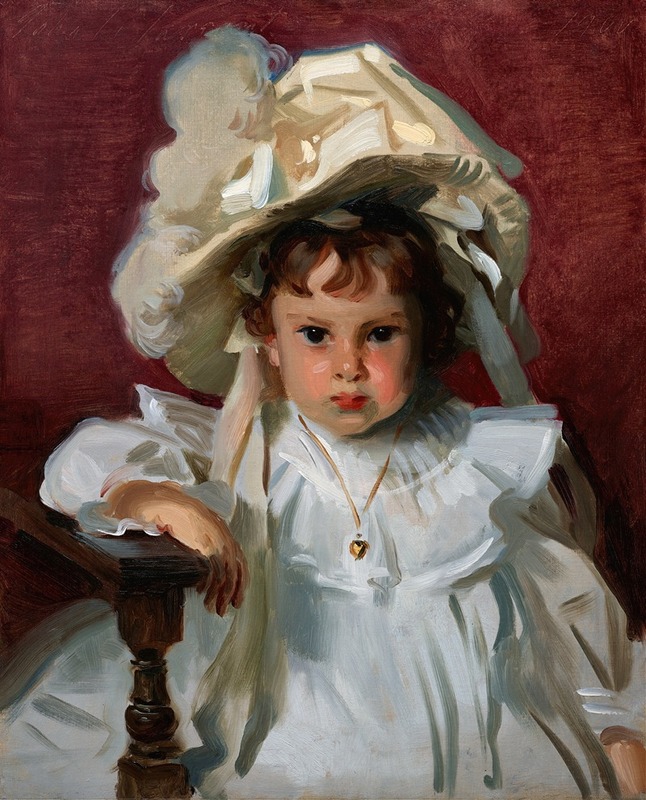
Dorothy
1900
- Dimensions
- 61.278 × 50.17 cm
- Medium
- Oil on canvas
- Collection
- Dallas Museum of Art (Dallas, Texas)

Born in Italy to American parents, he spent his early years in Paris before esta…
✦ Highlights (technique & color)
Rendered using the "alla prima" technique, applying paint directly onto the canvas. The folds of the pinafore dress are captured with single brushstrokes of gray; though appearing loose and rough up close, from a distance light and shadow fuse together to create a striking sense of three-dimensional form.
✦ The setting of this painting
Sargent's studio on Tite Street in London. In this lavish space adorned with antique silks, Chinese folding screens, a phonograph, and a grand piano, the young girl is seated in a distinctive armchair that was a permanent fixture of the studio.
✦ Historical context
At the turn of the century in 1900, dressing children as "little adults" and commissioning portraits from renowned painters served as a major status symbol among the upper classes of Europe and America.
A large feathered hat.
A girl in a pure white dress sits in a grand chair.
At the turn of the 20th century, in 1900.
Dressing children like miniature adults for portraits was a status symbol among the upper class.
Painted with Sargent's swift brushstrokes, this picture appears to be a perfect record of an adorable girl.
However, in reality.
It seems the painting was not a happy memory for the subject herself.
The model was Dorothy Williamson, who was two or three years old at the time.
Her grandfather was George Miller Williamson.
He was an American collector of first editions of modern literature and a patron of Sargent.
He commissioned a portrait of his granddaughter, and work began in Sargent's Tite Street studio in London.
It was a luxurious space adorned with antique silks and Chinese screens.
A gramophone and a grand piano were also present to entertain clients.
Dorothy was seated in a distinctive armchair that was always kept in the studio.
However, she was a two or three-year-old toddler.
Sargent was desperate to capture her attention as she moved around.
He tried to distract her with oranges and toys.
He played the piano improvisationally.
He sang comical songs, trying to get her to hold her pose.
About 231 more words

Sign up free and enter Your Museum
Read the stories behind great paintings and music for free, in Your Museum
Your Note
Write down what this painting made you feel in your art notebook.
Please sign up to write notes.
Sign up for freeRecommended Artworks

Sources & references
More art movements
Pre-Baroque
1 artworks
Victorian era
10 artworks
Impressionism
48 artworks
Late Pre-Raphaelite
10 artworks
Baroque
2 artworks
American Impressionism
5 artworks
Realism
4 artworks
Pre-Raphaelite
3 artworks
Barbizon School
5 artworks
Academic art
5 artworks
Luminism
3 artworks
Rococo
2 artworks
Symbolism
22 artworks
Neo-Impressionism
3 artworks

Ukiyo-e
1 artworks
Japonism
4 artworks
Edo period
1 artworks
Fauvism
1 artworks
Naturalism
9 artworks
Russian Realism
1 artworks
Post-Impressionism
13 artworks
Genre painting
9 artworks
Neoclassicism
3 artworks
ウィーン分離派
7 artworks
自然主義
1 artworks
ナショナル・ロマンティシズム
1 artworks
未来派
1 artworks
More artists


If you find an error in this content, please let us know here
This site is protected by reCAPTCHA, and the Google Privacy Policy and Terms of Service apply.