日本語 (JA)
 English (EN)
1810–1849 (Poland)
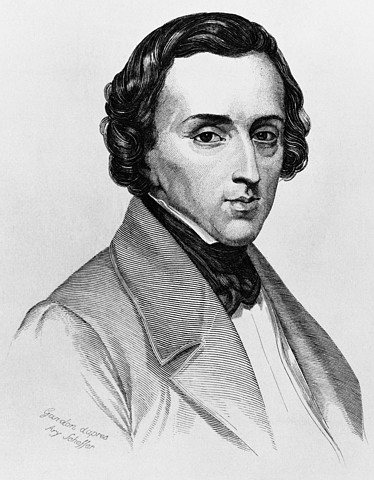
フリデリク・ショパンは、19世紀のロマン派音楽を代表するポーランド出身の作曲家であり、その生涯のほぼすべてをピアノ独奏曲に捧げた人物です。
A tale of innovation that spun an infinite acoustic space from the extreme constraint of just two chords. Above the steady swaying of a cradle, here lies an intricate sonic tapestry that demonstrates just how freely the piano can sing.
Listen to a recording
Berceuse in D-flat major, Op. 57
Piece Guide & Analysis
The Scene It Depicts: Why This Title?
Why did Chopin change the title of this piece, originally titled "Variations," to the descriptive title "Berceuse" (Lullaby) just before publication?
Summer 1843, Nohant in central France. Here lay the expansive country estate of the writer George Sand. Far removed from the clamor of Paris and the entanglements of high society, this natural sanctuary was the only paradise where Chopin could fully immerse himself in composition. By this time, his health had already deteriorated markedly, and a shadow was gradually falling over his relationship with Sand. Yet, in contrast to such inner melancholy and physical suffering, his creative work at Nohant was marked by intense concentration and unfettered creative freedom. As evidenced by his simultaneous work on monumental pieces like the Piano Sonata No. 3 in B minor, his artistic vitality was at its zenith.
In this quiet manor, Chopin spent gentle moments with a young girl: eighteen-month-old Louisette, daughter of the celebrated mezzo-soprano Pauline Viardot, a close friend of Chopin and Sand. While Pauline toured across regions on concert engagements, young Louisette was entrusted to Nohant, cared for by Sand and Chopin. Chopin was exceedingly fond of the charming child, and the peaceful moments spent soothing her are believed to have served as the direct inspiration for this tender, gentle music. Indeed, the fact that the first autograph sketch of this work was owned by the Viardot family for many years corroborates this intimate connection.
Regarding the origins of this piece, it is often said that the melody Chopin improvised on the spot to lull a crying Louisette to sleep became the piece itself; the reality, however, is quite different. Chopin spent more than a full year, from the summer of 1843 to the autumn of 1844, completing this work. He painstakingly and deliberately constructed the texture of the variations. While Louisette's presence was undeniably the spark of inspiration, research reveals that the compositional process itself was a profoundly intellectual, almost architectural undertaking.
Initially, the sketches Chopin kept bore not the title "Berceuse," but rather the simpler and formally descriptive "Variantes" (Variants / Variations). On the sketch manuscript, he had even numbered each individual variation. Yet in the final stages before publication, the title was changed to "Berceuse," French for "cradle rocker" or "cradle song." That Chopin himself ultimately endorsed such a descriptive title stands as an exceptionally rare occurrence within his entire oeuvre.
The Narrative: What Happens in This Piece?
Within a single movement, this piece unfolds a narrative that begins with the quiet rocking of a cradle and gradually draws the listener deep into a kaleidoscopic dream world. Across its compact span of just seventy measures, it condenses intricate polyphony—music woven from multiple independent voices—and formidable pianistic technique.
In a mere two-measure introduction, the left hand sets up the perpetual rocking of the cradle. Over this, the right hand gently lays down a simple, pure theme. Studies, including those by the Fryderyk Chopin Institute, confirm that the melodic contours of this theme strongly reflect the inflections of a traditional Polish folk song, "The Moon Has Risen, the Dogs Are Asleep." A romantic legend suggests it was a direct homage to a lullaby his mother sang to put him to sleep, but this is a later sentimental embellishment absent from Chopin's letters or family records. Nevertheless, the resonance of the ancient folk melodies of his beloved homeland undeniably flows beneath the surface of this piece.
After the theme is presented, the music unfolds across sixteen variations. Beginning with an interwoven dialogue in the inner voices, the right-hand figurations grow increasingly intricate and free, shifting through fluid ascending and descending sixteenth notes, delicate trills, and shimmering arpeggios. In Variation 8, a rapid high-register passage known as "rolling pearls" appears, while Variation 11 resounds with ethereal, misty trills. Toward the end, the piece reclaims its gentle lyricism before returning to silence.
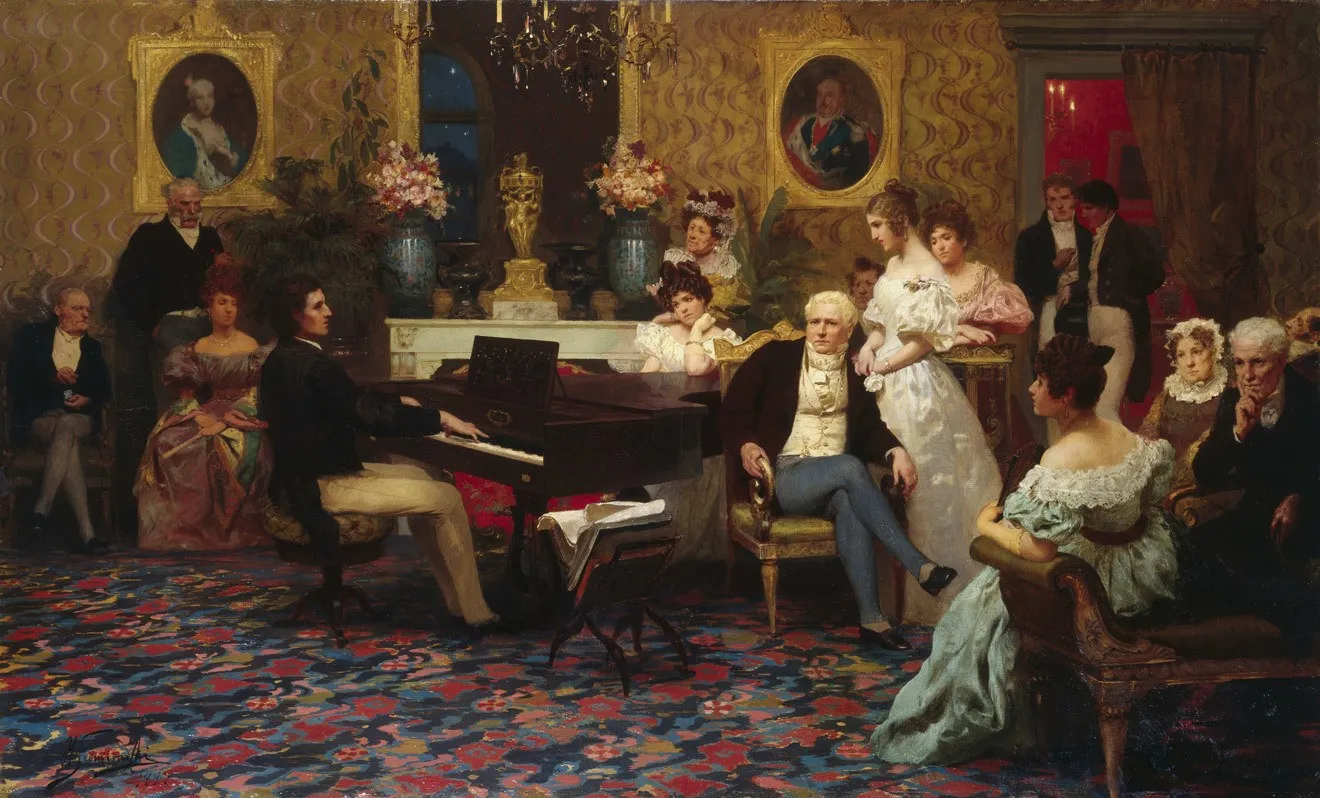
The piece was premiered in public on February 16, 1848, at a recital in Paris's Salle Pleyel—which would prove to be the final, historic concert Chopin ever gave in Paris. In the tense atmosphere of pre-revolutionary Paris, surrounded by candlelight and flowers, Chopin performed this work. Contemporary critics praised it as a "celestial mystery without equal on this earth," recording that it cast the audience into a state of profound enchantment.
This innovative concept of spinning an infinite variety of sound within an exhaustively restricted accompaniment exerted a far-reaching influence well beyond the Romantic era. For example, Peace Piece, the 1958 solo piano work by the legendary modern jazz pianist Bill Evans, shares this exact genetic blueprint. Evans likewise sustained an oscillation between just two chords in the left hand, over which his right hand wove freely improvised variations. Chopin's cradle song echoes forward across a century into the world of jazz.
Musical Analysis: A Sonic Tapestry Where Discipline and Freedom Intersect
To unlock the magic of this work, let us delve deeper through two perspectives: harmonic function and shifting rhythmic landscapes.
About 946 more words
- ・The true title hidden behind the Berceuse
- ・Days in Nohant with an eighteen-month-old girl
- ・The striking anomaly of a piece built eighty percent on just two chords
- ・A sonic experiment anticipating Impressionism by half a century
- ・The rhythmic friction born of discipline and freedom
Unlock this story's ending, and every article on MusicStory
¥07-day free trial
Unlimited access to 403 stories, paintings and pieces
- ・The first 7 days are completely free. Cancel within the trial and nothing is charged.
- ・From day 8, ¥980/month (tax incl.). Cancel anytime from your account page.
- 47Stories
- 343Paintings with commentary
- 13Music Library
- My Notes, unlimited
Already have an account? Log in
Your Note
Write down what you felt and learned from this piece in your art notebook.
Please sign up to write notes.
Sign up for freeSources & references
- www.youtube.com
- www.youtube.com
- www.youtube.com
- en.wikipedia.org
- www.henle.de
- classical.music.apple.com
- musicbrainz.org
- www.pianolibrary.org
- www.henle.de
- www.ficksmusic.com
- atuneadayblogdotcom.wordpress.com
- s9.imslp.org
- www.matthay.org
- www.researchgate.net
- musictales.club
- www.mundtmusic.com
- pl.wikipedia.org
- www.garrisonkeillor.com
- www.michael-moran.com
- polishmusic.usc.edu
This site is protected by reCAPTCHA, and the Google Privacy Policy and Terms of Service apply.
If you find an error in this content, please let us know here