
Your type is…
The Perfectionist Architect (OIMT)
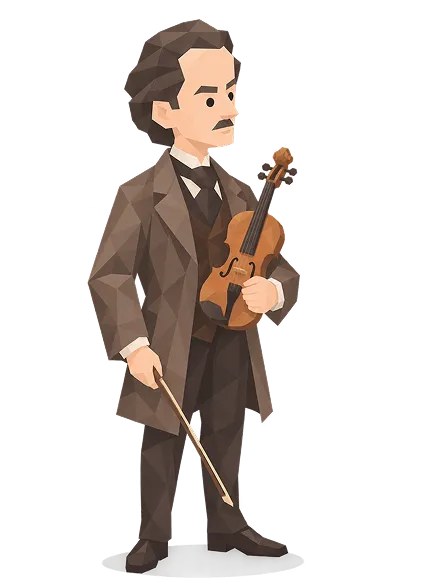
Johann Sebastian Bach
Paul Klee

- Order
- Inward
- Powerful
- Tradition
Building invisible beauty out of exact mathematics
Your sense of beauty
Imagine listening as heavy sound rises from a cathedral organ and layer upon layer of melody crosses in complexity. You are not drawn by surface brilliance; you want to verify the sturdy framework deep inside the work. You inherit the reliable theory earlier masters built, and you trust what has been assembled in three dimensions with something close to mathematical exactness. When you sink your attention deep into silence and meet the overwhelming breadth created by elements stacked many times over, you feel a firm answering pressure in your chest. You know that unshakeable beauty lives in calculation that leaves nothing to chance, and in deep structure laid down detail by detail.

What moves you
The instant several melodies mesh in perfect order and an enormous building of sound seems to rise in front of you. The same happens before a painting where geometric shapes and colors overlap in layers until the whole surface sounds as one chord.
The beauty you tend to overlook
Expression without a clear framework still holds charms you have not met. The fluid nuance that comes from an accidental bleed of color or an improvised waver will gently loosen a tightly held sensibility.
The composer in tune with you: Johann Sebastian Bach
In The Well-Tempered Clavier, Bach covered all twenty-four keys and demonstrated every pattern of development available to counterpoint, the craft of layering melodic lines. Even after taking up the post of Thomaskantor in Leipzig in 1723, he went on pursuing a geometry of sound. Music in which several melodies interlock in complexity and ring out like an enormous building resonates with your love of logical beauty.
Learn more about Johann Sebastian BachThe painter who resonates with you: Paul Klee
Klee taught at the Bauhaus and systematized a theory of form entirely his own. In Ad Parnassum (1932), layers of geometric points and lines build up on the surface a resonance like polyphonic music. A picture that raises an invisible structure into view through logical assembly resonates with your appetite for a meticulous beauty.
Learn more about Paul KleeWhat links the two
There is no historical connection between the two. But Klee revered Bach and played his music himself, translating its contrapuntal structure into painting; they share a quality of building beauty through mathematical assembly.
Art does not reproduce the visible; rather, it makes visible.
Paul Klee, Creative Credo, 1920
Who stands beside you changes the work
Walk through the same exhibition, hear the same performance, and what you take home still changes with the person standing beside you.
A type who is fun to go and see things with
Without a word between you, your hearts move in the same place.



A type who finds what you overlooked
Half of it overlaps, half of it shifts. They show you what you would have walked past.


A type who sees from a completely different point of view
You spend the same hours, and the painting or the piece each of you remembers is a different one.
Types close to yours
See the other types

 The Philosopher of SilenceOISNErik Satie × Edward Hopper
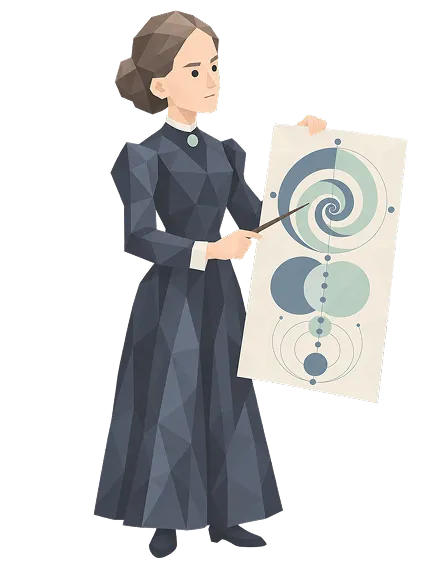 The Mystic VisionaryOIMNAlexander Scriabin × Hilma af Klint
 The Magician of ColorOESNMaurice Ravel × Henri Matisse
 The Avant-Garde PioneerOEMNIgor Stravinsky × Pablo Picasso
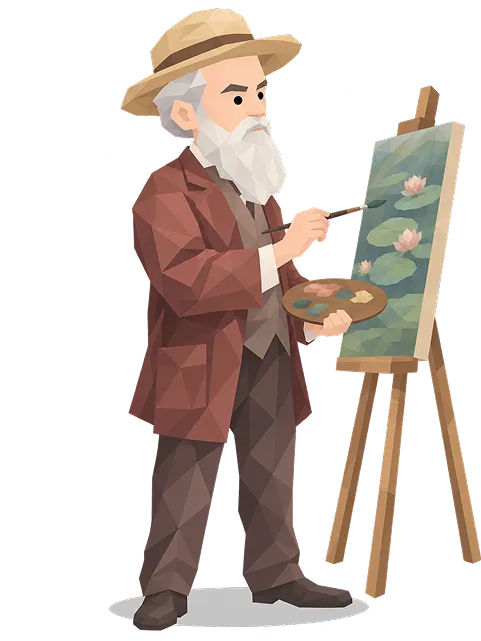 The Dreaming RomanticPISTFrédéric Chopin × Claude Monet
 The Poet of SorrowPIMTPyotr Tchaikovsky × Vincent van Gogh
 The Teller of NostalgiaPESTAntonín Dvořák × Jean-François Millet
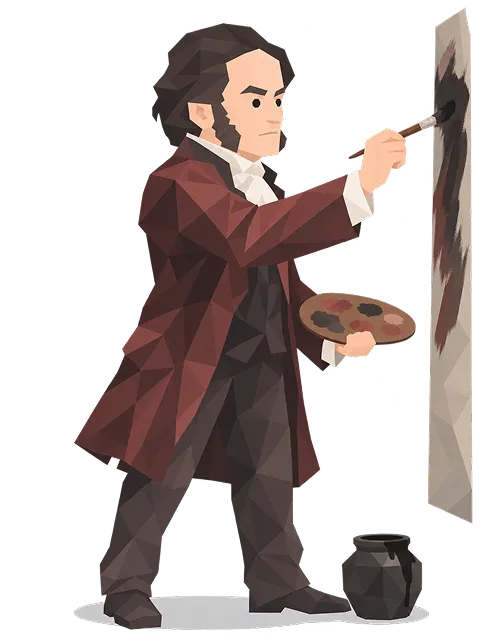 The Passionate RevolutionaryPEMTLudwig van Beethoven × Francisco de Goya
 The Solitary SeekerPISNJohannes Brahms × Caspar David Friedrich
 The Mad GeniusPIMNHector Berlioz × Edvard Munch
 The Free SpiritPESNFranz Liszt × Gustav Klimt
 The Iron-Willed ChallengerPEMNRichard Strauss × J. M. W. Turner

Where music and art meet,
stories that move you.
Reading that awakens a new sensibility

From “just looking”
to “reading” a painting
One painting becomes dramatically more interesting

The more you know,
the more you hear.
Commentary & analysis