
A French painter who liberated color from its role of imitating reality and, in his later years, unified line and color through his cut-outs.
LifeLife and works
Born in Le Cateau-Cambrésis in northern France in 1869, Henri Matisse initially studied law and worked as a notary's clerk. In his early twenties, while convalescing from acute appendicitis, his mother gave him a box of paints, prompting him to pursue painting. Having already studied drawing in evening art classes, he moved to Paris in 1891, where he learned academic techniques at institutions including the École des Beaux-Arts.
In 1896, on the island of Belle-Île in Brittany, he encountered Impressionism and the primary colors of Van Gogh, breaking away from somber chiaroscuro. However, his paintings found little commercial success, forcing him to get by on the income from his wife Amélie's millinery shop and odd jobs as a house painter. In 1902, his in-laws were swept up in the Humbert Affair—a massive financial fraud—and the hat shop closed. Left as the sole breadwinner for a family of seven, Matisse fell into severe economic hardship.
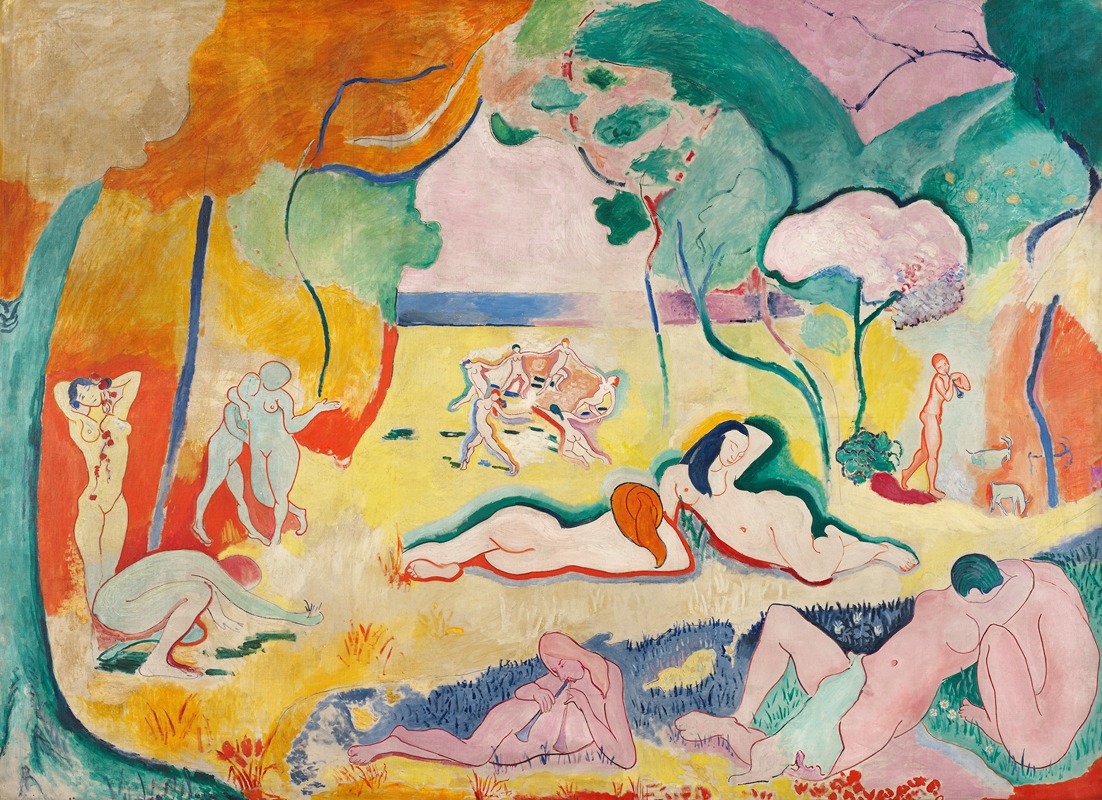
In 1904, he experimented with Neo-Impressionist pointillism, but determined that the dots stifled movement on the canvas. The following year, in 1905, he stayed in Collioure in the south of France, where the intense Mediterranean light led him to abandon chiaroscuro and simply juxtapose pure, unmixed colors. When he exhibited Woman with a Hat, depicting his wife, at that year's salon, critics scathingly dubbed the artists "fauves" (wild beasts) for canvases splashed with unmodulated green and yellow. However, the American collectors Leo and Gertrude Stein purchased the work, helping him escape financial crisis.
From 1908 onward, he began receiving commissions for large decorative paintings from the Russian industrialist Sergei Shchukin. In Harmony in Red, Matisse painted over what was initially a blue composition with a sweeping field of red just before an exhibition, dissolving the boundary between wall and table to unify the space with Oriental-inspired patterns. In The Red Studio (1911), he eliminated linear perspective indicating the depth of his atelier's floor and walls, enveloping the canvas in an expanse of reddish brown and dismantling Western spatial representation from within.
After moving to Nice in the south of France in 1917, he reexamined the relationship between color and light within figurative spaces centered on interior light and odalisques. In 1930, he received a commission for the large-scale mural Dance II from the Barnes Foundation in the United States; as a means of adjusting the compositional design, he introduced the technique of cut-outs, arranging shapes cut from prepainted paper.
In 1941, following surgery for duodenal cancer, Matisse became largely confined to a wheelchair. This prompted his full-scale transition to cut-outs, cutting directly into colored paper with scissors. Through this method, which united the acts of applying color and shaping form into a single gesture, he created Blue Nude II in 1952 using cobalt blue paper against the white space of the background. In the monumental cut-out The Sheaf, completed the following year, plant-like forms rendered in vibrant primary colors radiate across the entire composition.
Works Works
No works yet